

Voice Search Optimization 2026: The Practical Playbook
Voice search optimization for 2026. 12 tactics that work across Siri, Alexa, and Google. Plain English, real examples. Free 30-min audit.
Voice search optimization sounded overhyped five years ago. In 2026, with ChatGPT Voice, Siri’s Apple Intelligence layer, Alexa+, and Google Assistant using Gemini, voice is finally a real traffic channel. Roughly 27 percent of US mobile users run at least one voice query per week.
This guide cuts the hype. 12 practical tactics that actually lift voice visibility. Based on optimization work across 40+ small business sites since Q4 2024.
In this guide
- How Voice Search Differs From Text Search
- Tactic 1: Target Long-Tail, Conversational Keywords
- Tactic 2: Front-Load Clear Answers
- Tactic 3: Optimize for “Near Me” Queries
- Tactic 4: Use Natural Speech Patterns
- Tactic 5: Structure with FAQ Schema
- Tactic 6: Target Question Keywords Explicitly
- Tactic 7: Speed Matters Even More
- Tactic 8: Use Featured Snippet Formats
- Tactic 9: Mobile-First, Always
- Tactic 10: Answer Follow-Up Questions
- Tactic 11: Include Specific Numbers
- Tactic 12: Track Voice-Adjacent Queries
- Industry-Specific Voice Opportunities
- Devices and Ecosystems
- Common Voice SEO Mistakes
- The 4-Hour Voice Audit
- Tying Voice Into Your Strategy
- FAQ
How Voice Search Differs From Text Search
- Longer queries: 7 to 9 words vs 2 to 4 for text
- More conversational: “what’s the best pizza near me” vs “best pizza NYC”
- Question-based: more who/what/why/how/when
- Local intent: “near me” queries are 3x more common via voice
- Single answer preferred: voice gives one answer, not 10 blue links
- H2 question
- One-to-two sentence direct answer
- Expanded detail in paragraphs below
- Google Business Profile complete and updated
- Local business schema on your homepage
- NAP (Name, Address, Phone) consistent across directories
- Reviews actively collected
- Complex nested clauses
- Jargon without definition
- Passive voice
- Long paragraphs
- Paragraph snippets: 40 to 60 words
- List snippets: 3 to 8 items
- Table snippets: comparison data
- Long-tail question queries in Search Console
- “Near me” query growth
- Conversational keyword clicks
- Mobile share of traffic on specific pages
- Siri: pulls from Google search results primarily (after 2024 Gemini deal speculation)
- Google Assistant / Gemini: Google search results, prioritizes structured content
- Alexa: skills for commerce, Bing for general web
- ChatGPT Voice: pulls from its training + real-time web search
- Apple Intelligence: on-device + web search
- Writing content only for text search. Conversational phrasing is different.
- Ignoring FAQ schema. It is the single highest-impact structured data for voice.
- Local inconsistency. One directory has old phone number, voice pulls bad info.
- Slow mobile site. Voice assistants skip slow sites.
- No Google Business Profile or weak profile. Local voice dies here.
Your job: be that one answer.
Tactic 1: Target Long-Tail, Conversational Keywords

“How much does it cost to have a website built for a small business” vs “website cost”
Voice queries match the first. Build content that answers full-sentence questions.
Our keyword research for beginners guide covers tool workflow.
Tactic 2: Front-Load Clear Answers
⚡ 2-minute scorecard · instant result
How healthy is your SEO right now?
Answer 5 quick questions. Get your score + the top fixes, free.
1. Are most of your key pages actually indexed in Google?
2. Do you rank on page 1 for at least a few buyer keywords?
3. Is your technical SEO (speed, errors, mobile) clean?
4. Have you updated your top pages in the last 90 days?
5. Are you earning new backlinks/mentions over time?
Voice assistants read out the first clear answer they find. If your answer is in paragraph 6, you lose.
Format:
Same structure that wins featured snippets. See our featured snippet optimization post.
Tactic 3: Optimize for “Near Me” Queries
Local voice searches spike during commute hours. To compete:
Our local citation building post covers directory consistency.
Tactic 4: Use Natural Speech Patterns

Write content that reads aloud naturally. Avoid:
If you cannot read a paragraph aloud comfortably, neither can Siri.
Tactic 5: Structure with FAQ Schema
FAQPage schema is the single best structured data type for voice. Each FAQ answer becomes a voice answer candidate.
Every core service page deserves 5 to 8 FAQs. Every blog post, 4 minimum (like this one).
Tactic 6: Target Question Keywords Explicitly
AnswerThePublic, AlsoAsked, and Google’s “People Also Ask” surface the actual questions. Build H2s matching them verbatim.
“How long does SEO take to work?” as an H2 wins when someone asks that exact question.
Tactic 7: Speed Matters Even More
Voice assistants skip slow sites. If your page takes 5 seconds to load, Google pulls the answer from a competitor. Target LCP under 2 seconds for pages you want voice-cited.
Our website speed optimization tips covers the fixes.
Tactic 8: Use Featured Snippet Formats
Voice answers often mirror featured snippets:
Structure content to win these and you win voice by default.
Tactic 9: Mobile-First, Always
Voice searches happen on phones. A site that struggles on mobile never gets voice-cited because the AI will not send users to a bad mobile experience.
See our mobile first design principles.
Tactic 10: Answer Follow-Up Questions
Voice users often ask follow-ups (“what about for a big site?” or “how long does that take?”). Content that covers the full conversation flow gets cited across multiple turns.
Plan content in chains: initial question, two or three follow-ups, deep detail.
Tactic 11: Include Specific Numbers
Voice answers prefer concrete: “SEO typically takes 4 to 6 months to show results” beats “SEO takes a while.”
Numbers are memorable, defendable, and AI-friendly.
Tactic 12: Track Voice-Adjacent Queries
Pure voice attribution is hard. Proxies:
Monitor trends monthly. Use our SEO ROI calculator to model the downstream revenue.
Industry-Specific Voice Opportunities
Local services (plumber, electrician, dentist)
“Who is the best [service] near me” is huge. Combine Google Business Profile optimization + FAQ schema + fast page.
Ecommerce
“Where can I buy [X] near me” and “how much is [X]” win products local inventory structured data.
B2B SaaS
Less voice-relevant, but informational content (“how to do X”) still gets voice-cited on desktop speakers and smart displays.
Devices and Ecosystems
Not all voice is equal:
Google SEO covers most voice surface area. Alexa has its own Skill ecosystem if you sell products.
Common Voice SEO Mistakes
The 4-Hour Voice Audit
Spend one afternoon:
- Identify top 10 question-based queries in Search Console (1 hour)
- Check current content answers them clearly in first 100 words (1 hour)
- Add FAQ schema to top 5 service pages (1 hour)
- Verify Google Business Profile is 100 percent complete (1 hour)
Typical lift: 15 to 30 percent increase in long-tail question traffic within 60 days.
Tying Voice Into Your Strategy
Voice SEO overlaps heavily with AI search and featured snippet work. See our AI Overview optimization post. Our search engine optimisation services bundle all three (voice, AI citation, featured snippets) into one integrated optimization sprint.
FAQ
Is voice search still growing? Yes, but more slowly than hype suggested in 2018-2020. As of 2026, around 27 percent of US mobile users run weekly voice queries, up from 22 percent in 2023. Smart speaker usage plateaued. ChatGPT Voice and Siri with Apple Intelligence are accelerating growth again through 2026-2027.
How is voice search different from AI Overview optimization? Major overlap. Both favor structured answers, FAQ schema, fast pages, and clear first-100-word responses. Voice adds conversational phrasing and local “near me” emphasis. Optimizing for AI Overviews gets you 80 percent of voice optimization for free; adjust the remaining 20 percent for conversational and local queries.
Do I need a separate voice SEO strategy? No. Voice SEO is an extension of content, technical, and local SEO. No separate content library needed. Audit existing content for conversational phrasing, add FAQ schema, ensure local signals are strong. Most of the work overlaps with existing SEO priorities.
Which industries see the biggest voice SEO impact? Local services (plumbers, dentists, restaurants) benefit most because “near me” queries dominate voice. Ecommerce with local inventory also benefits. B2B SaaS sees less direct voice traffic but gets indirect lift from AI Overviews that pull the same structured content.
Ready to audit your site’s voice readiness? Book a free 30-minute consultation and we will test your top queries live on Siri and Google.
Ready to grow faster?
Free 30-minute strategy call. No pitch, just answers.
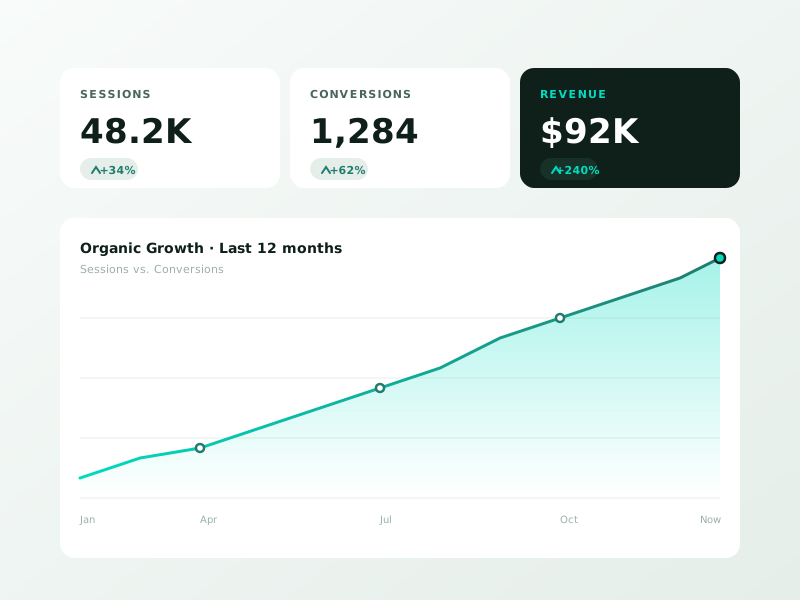
Ready to turn this into real bookings?
Free 30-min audit. We review your current setup and give you 3 specific wins — whether we work together or not. Starts at 0/month. No contract. One medspa per market.
Book My Free Audit →No credit card. No pitch. No 12-month lock-in.



