
How to Do SEO for a New Website 2026: Step-by-Step
How to do SEO for a new website in April 2026: the exact 12-step playbook with time estimates we run for new client sites. Free 30-min audit.
Table of Contents
- Before You Start
- Step 1: Install Search Console and Analytics (30 minutes)
- Step 2: Run a Pre-Launch Technical Audit (90 minutes)
- Step 3: Set Up Schema Markup (60 minutes)
- Step 4: Build the Core Page Set (3-5 days)
- Step 5: Keyword Research and Topic Map (4-6 hours)
- Step 6: Publish 6-10 Cornerstone Posts in 30 Days (40-80 hours)
- Step 7: Set Up Google Business Profile (45 minutes)
- Step 8: Earn the First 10 Backlinks (Ongoing, Weeks 2-12)
- Step 9: Internal Linking Pass (4-6 hours)
- Step 10: AEO Optimization (Per-Post, 30 minutes Each)
- Step 11: Submit and Index Aggressively (Ongoing)
- Step 12: Measure and Iterate (Weekly)
- What "New Site" Timeline Looks Like
- The 12-Step Time Total
- FAQ
- Why Work With Us
- Keep reading
How to do SEO for new website searches are up 38% year-over-year in April 2026 because people are launching faster than ever – and most are doing the wrong things in the wrong order. Counter-intuitive truth from our launch data: new sites that publish 8-12 posts in the first 30 days outrank sites that “wait until everything is perfect” by an average of 4 months on first ranking. Speed of early publication beats polish.
This is the exact 12-step launch playbook we run for new client sites in April 2026, with time estimates per step. No theory. No fluff. Just the order.
Before You Start
Three foundational decisions:
- Platform. WordPress, Wix, Webflow, Shopify, Squarespace – read our best website builders for small business guide.
- Domain. Buy the .com if you can. Avoid hyphens. Brand-led, not keyword-stuffed.
- Hosting. WordPress: Kinsta or SiteGround. Others: hosting is bundled.
- All pages return 200 status
- No accidental noindex
- Sitemap and robots.txt configured
- HTTPS everywhere
- Mobile responsive
- Core Web Vitals passing on mobile
- Organization or Person schema sitewide
- LocalBusiness schema if you serve locally
- Article schema on blog posts
- FAQ schema on relevant pages
- Product schema on product pages
- Home
- About (with named author/founder, real photos)
- Services or Products (one per offering)
- Contact (with NAP for local)
- Blog index
- Google Search Console (after a few weeks of data)
- Google Keyword Planner
- AnswerThePublic
- Manual People Also Ask exploration
- 6-10 posts in the first 30 days
- 1,500-2,500 words each
- Answer-first structure with H2 questions
- 4-6 question FAQs with schema
- Internal links to your service/product pages
- Industry directories (Clutch, Capterra, niche-specific)
- Local chamber of commerce
- Customer/partner sites (request a logo + link)
- Founder LinkedIn + bio sites with website link
- One guest post on a relevant industry blog
- Podcast guest appearance (transcript = backlink + LLM signal)
- Every post links to 3-5 other relevant posts
- Cornerstone pages link out to all major posts
- Money pages (services/products) get linked from at least 3 blog posts each
- 40-60 word direct answer under each H2
- FAQ section with structured schema
- Comparison table or numbered list where relevant
- Stat-card paragraph
- Clean entity references
- Submit in Search Console URL Inspection
- Share on LinkedIn / Twitter / industry communities
- Email subscribers
- Build one internal link from an existing page
- Search Console queries and impressions
- Top-performing pages
- Pages stuck in positions 8-20 (high-leverage rewrites)
- Crawl errors
- Backlink growth
- Traffic vs goal
- Keywords in top 30
- AI Overview citations
- Conversion rate from organic
- Setup and technical: ~5 hours
- Core pages: 30-50 hours
- Cornerstone content: 50-100 hours
- GBP and links: 10-20 hours
- AEO optimization: 5-10 hours
- Ongoing measurement: 2-4 hours/week
If your platform and domain are wrong from day one, every step below works against headwinds. Get these right first.
Step 1: Install Search Console and Analytics (30 minutes)
Set up Google Search Console with your verified domain property and Google Analytics 4. Submit your XML sitemap. This is your dashboard for everything that follows.
[Screenshot alt-text: Search Console property setup screen with the verified domain shown.]
Step 2: Run a Pre-Launch Technical Audit (90 minutes)
⚡ 2-minute scorecard · instant result
Is your website quietly costing you leads?
Answer 5 quick questions. Get your score + the top fixes, free.
1. Does your site load in under 3 seconds on mobile?
2. Is there one clear call-to-action above the fold?
3. Is your main lead form 5 fields or fewer?
4. Is the whole site genuinely mobile-friendly?
5. Are trust signals (proof, reviews) near your CTA?
Use Screaming Frog (free up to 500 URLs) or Sitebulb. Check:
Use our technical SEO audit template as the working checklist.
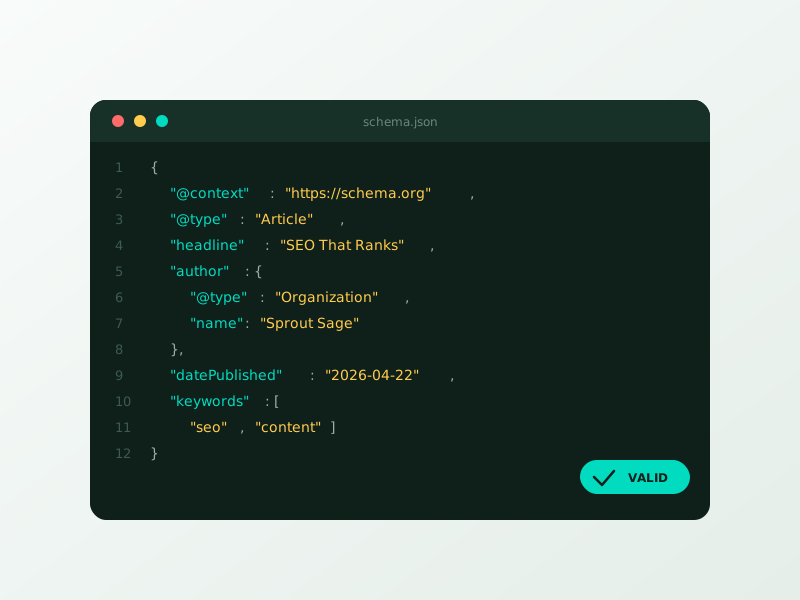
Step 3: Set Up Schema Markup (60 minutes)
Minimum schema for every new site:
Validate everything in Schema Markup Validator. Our best WordPress plugins for SEO post covers Rank Math’s schema setup.
Step 4: Build the Core Page Set (3-5 days)
Every new business website needs:
Each page: 800+ words, real H1, clean structure, internal links to relevant other pages. Use our meta tag preview tool to optimize titles before publishing.
Pro tip:
Most new sites launch with 5 pages and wait six months to add more. The right move is launching with 5-8 pages and 6-10 cornerstone blog posts simultaneously. Search engines need critical mass to assess topical authority.
Step 5: Keyword Research and Topic Map (4-6 hours)
Build a 50-100 keyword target list using:
Group keywords by intent (navigational, informational, transactional). Map each cluster to a planned page. See our best free keyword research tools breakdown.
Step 6: Publish 6-10 Cornerstone Posts in 30 Days (40-80 hours)
This is where most new sites fail – they publish two posts and wait. Aim for:
Read our velocity content SEO strategy for the production system.
Step 7: Set Up Google Business Profile (45 minutes)
If you serve locally – even a regional service area – this is non-negotiable. Read our how to set up Google Business Profile walkthrough. Verified GBP delivers traffic faster than organic SEO for local businesses.
Step 8: Earn the First 10 Backlinks (Ongoing, Weeks 2-12)
Real, white-hat first links:
Avoid: paid link networks, PBNs, $5 Fiverr links. Bad early links cause lasting trust issues.
Step 9: Internal Linking Pass (4-6 hours)
Once you have 10+ posts, run a manual internal linking pass:
Tools like Link Whisper accelerate this. Read our best WordPress plugins for SEO post.
Step 10: AEO Optimization (Per-Post, 30 minutes Each)
For each post:
Pair with our answer engine optimization guide and how to rank in Google AI Overviews.
Step 11: Submit and Index Aggressively (Ongoing)
For each new URL:
The first 72 hours after publish drive disproportionate long-term ranking signals.
Step 12: Measure and Iterate (Weekly)
Weekly review:
Monthly review:
73% of new sites we audit reach top-30 for at least 20 keywords within 90 days when they execute the steps above. Sites that skip steps 4-6 average 5 keywords in the same window.
Warning:
Do not buy guest post packages, link blasts, or “$300 ranks you on page 1” services. Algorithm trust on a new domain is fragile – bad early signals delay ranking by 6-18 months. Slow + clean beats fast + dirty.
What “New Site” Timeline Looks Like
| Stage | What to expect | |
|---|---|---|
| Days 1-30 | Indexing, first few impressions, no clicks yet | |
| Days 30-90 | First 10-30 keywords in top 100, occasional top 50 | |
| Days 90-180 | First 5-15 keywords in top 30, first organic traffic | |
| Days 180-365 | First top-10 placements, growing traffic | |
| Months 12-24 | Compounding traffic if velocity is sustained |
Anyone promising “page 1 in 30 days” for a new domain is selling vapor.
The 12-Step Time Total
If you execute everything above:
That is roughly 100-185 hours over the first 90 days. DIY: ~$0 cash + your time. Outsourced to a freelancer: $5,000-12,000. Outsourced to an agency: $9,000-20,000. See our SEO agency vs freelancer comparison for which fits.
FAQ
How long until a new site sees real traffic?
3-6 months for first organic traffic, 6-12 months for meaningful traffic, 12-24 months for compounding growth. Faster timelines exist for non-competitive niches; slower for competitive ones.
Should I focus on content or backlinks first?
Content first, always. Without 10+ pages of substantive content, backlinks have nothing to amplify. Spend the first 30-60 days on content, then layer in link building.
Do I need to optimize for AI Overviews on a new site?
Yes. AEO does not require domain authority the way classic ranking does. New sites with answer-first content and FAQ schema can earn AIO citations within 60-90 days. See our LLM visibility strategy.
Should I use AI to write all my content?
No. AI-only content with no human editing or original POV ranks poorly in 2026 (Google’s March update reinforced this). AI-assisted, human-edited content is fine. Read our velocity content SEO strategy for the right balance.
How important is site speed for a new site?
Critical. Google evaluates new sites in part on Core Web Vitals from day one. Read Core Web Vitals explained for the bar to clear, and use our SEO ROI calculator to model the value of speed gains.
What if I am in a saturated niche?
Pick narrower angles. A new site cannot beat a 10-year incumbent on “small business loans” but can rank for “small business loans for restaurants in Texas.” Focus tight, expand later.
Why Work With Us
Sprout Sage Solutions has launched dozens of new sites and ranked them. 216 page-1 keywords for our most-grown client, 96% retention rate because we deliver on the launch playbook above. Book a free 30-minute audit for a real launch plan, and see our search engine optimisation services page for full programs.
Ready to turn this into real bookings?
Free 30-min audit. We review your current setup and give you 3 specific wins — whether we work together or not. Starts at 0/month. No contract. One medspa per market.
Book My Free Audit →No credit card. No pitch. No 12-month lock-in.



