
Shopify SEO Services at $800/Month: Why Shopify Needs Different SEO Than WordPress
Shopify SEO services explained, canonical issues, collection page optimization, product schema, and why $800/month is the right investment for serious Shopify stores.
Table of Contents
- Why Shopify SEO Is Not the Same as WordPress SEO
- Shopify-Specific Technical SEO Checklist
- Product Schema for Shopify: What "Structured Data" Actually Means
- Shopify SEO Case Study: What $800/Month Delivers
- Shopify SEO vs. WordPress SEO: Platform Comparison
- Shopify SEO Pricing: What You Should Pay in 2026
- Questions Shopify Store Owners Ask Us
- Book Your Free Shopify SEO Strategy Call
Shopify makes it easy to launch an online store. It does not make it easy to rank in Google. The platform’s architecture introduces SEO challenges that don’t exist in WordPress, and most generic SEO agencies don’t know how to handle them properly.
If you’re running a Shopify store and wondering why your rankings have plateaued, why your collection pages aren’t indexing properly, or why you’re getting traffic but not conversions from organic search, this guide is for you.
We work with 65+ SMBs across the US, UK, Canada, and Israel, including a growing number of Shopify store owners who came to us after watching their organic traffic stagnate despite paying for “SEO services.” Here’s what they were missing.
Ready to fix your Shopify SEO? Book a free 30-minute strategy call →
—
Why Shopify SEO Is Not the Same as WordPress SEO
Most SEO practitioners learned their craft on WordPress. The plugin ecosystem (Yoast, RankMath, All in One SEO) handles much of the technical infrastructure automatically. Shopify’s architecture is fundamentally different, and the differences create specific problems.
The Canonical URL Problem
Shopify’s default URL structure creates duplicate content issues that can silently suppress rankings. Specifically:
The /products/ and /collections/products/ duplicate: Shopify generates two accessible URLs for every product:
- `/products/your-product-name`
- `/collections/collection-name/products/your-product-name`
Both URLs return the same content. Shopify adds a canonical tag pointing to `/products/`, but this is imperfectly implemented and can cause crawl budget issues on large stores. Googlebot wastes crawl budget on the duplicate URL set instead of prioritizing new content.
The pagination problem: Shopify’s collection pages use JavaScript-rendered pagination in newer themes. Google’s ability to crawl JavaScript pagination is inconsistent, meaning pages 2+ of large collections may never get indexed.
The filter URL problem: Dynamic faceted navigation (filtering by color, size, material) generates near-infinite URL variations. Without proper canonicalization or noindex rules on filtered views, these dilute crawl budget and create thin content signals.
Collection Page Optimization: The Most Underused SEO Asset
Most Shopify stores have minimal content on collection pages, a title, maybe a subtitle, and a grid of products. From Google’s perspective, a collection page with 200 words of unique content outranks an identical page with 20 words of filler text, everything else being equal.
Collection pages represent your highest-value ranking opportunities. They target broader commercial keywords (“men’s running shoes,” “organic skincare,” “professional cookware”) that drive significant search volume. Treating them as layout containers rather than SEO assets is a consistent missed opportunity.
Properly optimized Shopify collection pages include:
- Unique, keyword-rich introductory content (150–300 words minimum)
- Clear H1 targeting the collection’s primary keyword
- Internal links to related collections and top products
- FAQ sections targeting “people also ask” queries
- Structured data for the collection
—
Shopify-Specific Technical SEO Checklist
| Issue | Default Shopify Behavior | Fix Required |
|---|---|---|
| Duplicate product URLs | Both `/products/` and `/collections/…/products/` accessible | Verify canonical implementation; use Shopify's URL canonicalization correctly |
| Paginated collection indexing | JS pagination may not fully index | Implement JSON-LD pagination or ensure Googlebot can crawl all pages |
| Filter/facet URLs | Generates unique URLs for each filter combination | Noindex filtered URLs or use canonical to collection root |
| Duplicate page titles | Many themes generate duplicate `<title>` patterns | Customize title templates in theme settings |
| Thin product descriptions | Default product pages often lack sufficient unique content | Add minimum 200-word unique descriptions per product |
| Missing product schema | Basic schema only; missing Review, Offer aggregation | Implement comprehensive Product schema with JSON-LD |
| Blog treated as secondary | Blog is an afterthought in most Shopify themes | Ensure blog follows proper H1/H2 hierarchy and is crawlable |
| Site speed (image-heavy stores) | Large product images default | WebP conversion, lazy loading, Shopify CDN optimization |
—
Product Schema for Shopify: What “Structured Data” Actually Means
⚡ 2-minute scorecard · instant result
Is your store leaving money on the table?
Answer 5 quick questions. Get your score + the top fixes, free.
1. Do you track ROAS against your true margin (not revenue)?
2. Do you have an abandoned-cart recovery flow live?
3. Is product + review schema on your product pages?
4. Does your store load fast on mobile?
5. Does email/SMS drive 20%+ of your revenue?
Structured data (schema markup) tells Google exactly what your content means, not just what it says. For Shopify stores, the high-priority schema types are:
Product Schema: Signals product name, description, SKU, brand, and pricing. Required for eligibility in Google Shopping organic (free product listings) and rich snippet display.
Offer Schema: Nested within Product, signals availability (InStock, OutOfStock, PreOrder), price, currency, and seller. Directly influences whether Google shows pricing in search results.
AggregateRating Schema: Signals review count and average rating. Enables star ratings in organic search results, one of the most significant CTR improvements available in SEO. A product with 4.8 stars (847 reviews) displayed in search results gets dramatically more clicks than an identical listing without ratings.
BreadcrumbList Schema: Enables breadcrumb display in search results. Improves CTR and helps Google understand your site hierarchy.
Most Shopify themes implement basic Product schema but omit Offer and AggregateRating, or implement them incorrectly. Validation in Google’s Rich Results Test will show exactly what’s missing.
—
Shopify SEO Case Study: What $800/Month Delivers
A US-based Shopify store selling premium outdoor gear came to us with stagnant organic traffic despite 18 months of “SEO work” from a previous agency. Their issues:
- 847 duplicate product URLs uncanonicalized
- Collection pages with an average of 12 words of unique content
- No AggregateRating schema despite 2,300+ customer reviews
- JavaScript pagination preventing indexing of collection pages beyond page 1
- Site loading at 5.4 seconds on mobile (LCP failure)
What we did in 90 days:
- Canonical URL audit and remediation, eliminated 847 duplicate signals
- Collection page content expansion, added 200–300 word introductions to 24 key collections
- AggregateRating schema implementation, pulled reviews from their review app via JSON-LD
- Pagination fix, implemented HTML fallback for non-JS crawlers
- Image optimization, converted 1,200+ product images to WebP; mobile LCP improved to 2.1 seconds
Results at 6 months:
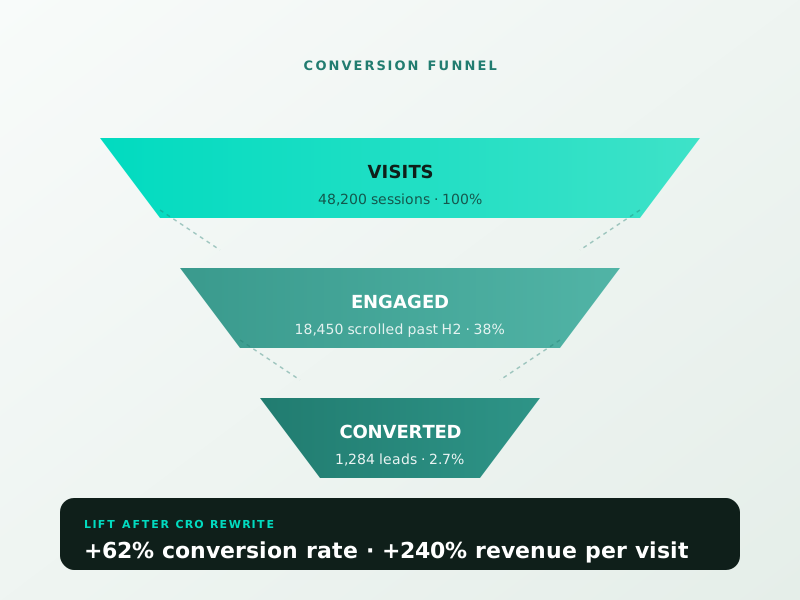
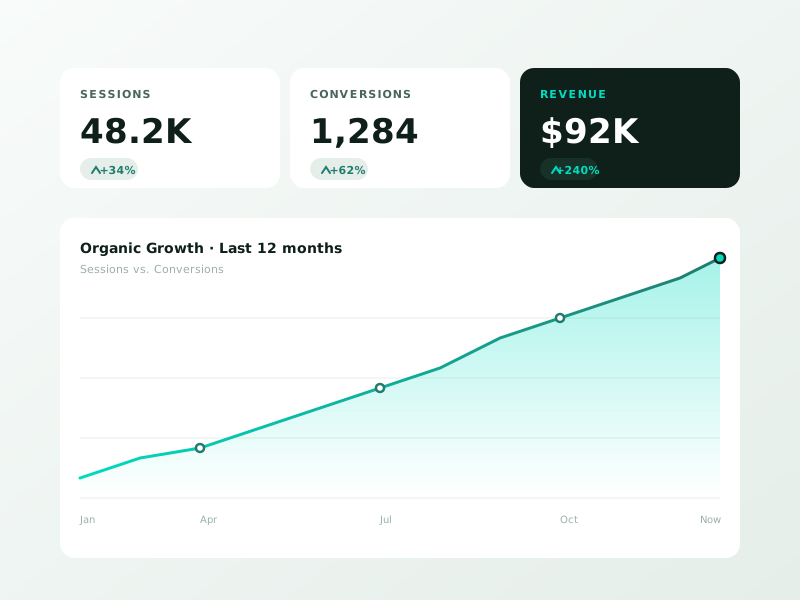
- Organic impressions increased 340% (Google Search Console)
- Organic sessions up 180%
- 14 collection pages moved to page 1 for their target keywords
- Average order value from organic traffic increased 22% (organic traffic converted at higher intent than previously)
This is what $800/month buys when the work is scoped and executed correctly.
—
Shopify SEO vs. WordPress SEO: Platform Comparison
| Factor | Shopify SEO | WordPress/WooCommerce SEO |
|---|---|---|
| Technical control | Limited, theme-dependent | Full, direct template control |
| Canonical management | Built-in but imperfect | Plugin-managed, highly flexible |
| Schema implementation | Limited native support | Full plugin ecosystem |
| Site speed | Generally faster baseline | More variable, developer-dependent |
| Blog functionality | Basic, not purpose-built | Full CMS capability |
| Multi-language SEO | Limited native | Full hreflang support available |
| Faceted navigation | Problematic by default | Manageable with proper setup |
| Difficulty to "break" SEO | Moderate | High (more moving parts) |
Shopify’s constrained environment means fewer things can go catastrophically wrong, but also fewer degrees of freedom to optimize. An expert Shopify SEO practitioner works within those constraints effectively.
—
Shopify SEO Pricing: What You Should Pay in 2026
| Engagement Type | Monthly Cost | Scope |
|---|---|---|
| DIY using Shopify SEO apps | $0–$50/month | Apps help but don't replace strategy |
| Freelancer | $300–$600 | Limited scope, one person |
| Mid-market specialist agency | $800–$1,500 | Full technical + content + schema + reporting |
| Enterprise Shopify agency | $3,000–$8,000+ | Large stores, custom development |
Our Shopify SEO services start at $800/month. This covers:
- Full Shopify-specific technical audit
- Canonical and duplicate URL remediation
- Collection page optimization (content + schema)
- Product schema implementation
- Monthly content (blog posts targeting long-tail keywords)
- Monthly reporting with keyword rankings and traffic data
- No 12-month contracts
—
Questions Shopify Store Owners Ask Us
“Can’t a Shopify SEO app handle this?” Apps like Plug In SEO or Smart SEO help with meta tags and basic schema. They don’t address canonical architecture issues, write collection page content, build links, or develop a keyword strategy. Apps are infrastructure; strategy is the differentiator.
“My site gets traffic but doesn’t rank for buyer-intent keywords.” This is a keyword strategy problem, not a traffic problem. Informational traffic (“how to choose running shoes”) converts at 0.5–1%. Commercial traffic (“best trail running shoes under $150”) converts at 3–5%+. Ranking for the right keywords is the work.
“Is $800 appropriate for a store with 50 products?” Scope determines cost. A 50-product store needs less technical infrastructure work than a 5,000-product store. We’d scope accordingly, our $800 starting point reflects full-service work for a store of moderate complexity.
—
Book Your Free Shopify SEO Strategy Call
If your Shopify store has more than six months of history and your organic traffic hasn’t grown proportionally to your product catalogue, something structural is likely wrong. We’ll identify it.
Book your free Shopify SEO strategy call →
Phone: +91 9729712388 | sproutsagesolutions.com
65+ SMBs across the US, UK, Canada, and Israel trust Sprout Sage Solutions for SEO that actually moves the needle.
Ready to turn this into real bookings?
Free 30-min audit. We review your current setup and give you 3 specific wins — whether we work together or not. Starts at 0/month. No contract. One medspa per market. Book a free 30-minute strategy call, I will review your setup and give you 3 specific fixes.
Book My Free Audit →No credit card. No pitch. No 12-month lock-in.



