

SEO for SaaS Companies: The 2026 Growth Playbook
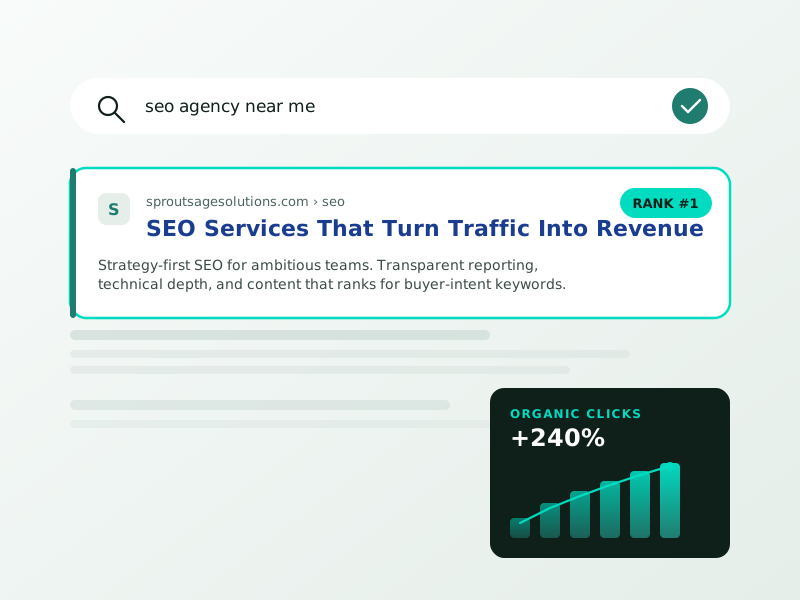
SEO for SaaS companies that actually drives pipeline. 12 plays from 60+ B2B SaaS SEO engagements. Free 30-min audit.
SEO for SaaS companies is different from every other vertical. You are not selling to consumers in a city; you are selling software to buyers across continents with complex decision processes. The SEO playbook reflects that.
This guide distills work across 60+ B2B SaaS SEO engagements since 2019. Everything here is tested, including the plays we stopped recommending.
In this guide
- Why SaaS SEO Is a Category of Its Own
- Play 1: Bottom-of-Funnel Keywords First
- Play 2: Competitor Comparison Pages
- Play 3: Alternatives Pages
- Play 4: Integration Pages
- Play 5: Use Case Pages
- Play 6: Programmatic SEO (Carefully)
- Play 7: Developer Content for API-Led SaaS
- Play 8: Review Site Optimization (G2, Capterra, Trustpilot)
- Play 9: Customer Story Pages
- Play 10: AI Overview and Citation Strategy
- Play 11: International SEO from Day One
- Play 12: Track SaaS-Specific Metrics
- SaaS SEO Budget Expectations
- Tech Stack Considerations
- Common SaaS SEO Mistakes
- Tying It Together
- FAQ
Why SaaS SEO Is a Category of Its Own
- Longer sales cycles: 30 to 180 days typical
- Multiple buyer personas: user vs buyer vs decision-maker
- Bottom-of-funnel queries are gold: high intent, high convert
- Product-led signals matter: AI Overviews cite products with strong reviews/G2 presence
- International from day one: hreflang and multi-country considerations
- “Best [category] for [use case]”
- “[Competitor] alternatives”
- “[Competitor] vs [another competitor]”
- “[Category] pricing”
- “[Product] integrations”
- “[Your product] vs [Competitor]”
- Honest comparison (yes, including where they are better)
- Feature table
- Pricing comparison
- Use case fit
- Migration info
- Why people leave [Competitor]
- Top alternatives (including you, honestly positioned)
- Comparison table
- “Why we are a good fit if you need X”
- “[Your product] + [Other tool] integration”
- What the integration does
- Setup steps
- Use cases
- Video or GIF demo
- “Project management for agencies”
- “Project management for software teams”
- “Project management for remote teams”
- “[Job title] resume template”
- “[City] cost of living calculator”
- Directory pages
- Unique data per page
- Real utility (not just keyword spam)
- Manual review for quality tier
- Docs must rank (fast, clean, good schema)
- Tutorial content targeting “how to [code task]”
- Code snippets with language tags (attracts GitHub referrals too)
- OpenAPI or Postman collection linkable
- Claim and fully optimize profiles
- Drive reviews systematically
- Respond to reviews
- Leverage “leader” badges on your site
- Industry + use case in title (“How [Industry] Company [Outcome] with [Your Product]”)
- Real metrics
- Quotes with real names
- Implementation details
- Schema markup (Article + customer Organization)
- Review aggregators (G2, Capterra)
- Product comparison sites
- Content hubs with strong E-E-A-T
- The product’s own help docs if they rank well
- Subdirectory (/de/) or subdomain (de.site.com) structure
- Hreflang tags correctly implemented
- Localized content (not just translated)
- Local pricing and compliance callouts
- Trial signups from organic
- Trial-to-paid conversion by source
- Annual contract value by acquisition channel
- Payback period on SEO investment
- LTV to CAC ratio
- Early-stage startup (pre-Series A): $3k to $8k/month
- Series A to B: $8k to $20k/month
- Series B to C: $20k to $50k/month
- Series C+: $50k+/month
- Website platform: Webflow, Next.js, or well-tuned WordPress (headless). Avoid Wix for serious SEO.
- CMS for content: whatever you build on. Sanity, Contentful, or WordPress work.
- Analytics: GA4 + product analytics (Amplitude, Mixpanel) tied via UTMs
- SEO tools: Ahrefs or Semrush mandatory, SEOmonitor optional
- Writing 50 “what is X” posts. AI Overviews own these now. Focus bottom-funnel.
- Ignoring competitor comparison pages. Single highest-ROI page type.
- Neglecting docs SEO. Docs drive both support deflection and new-user signup.
- No attribution from SEO to revenue. If you cannot tie content to ARR, budget will be cut.
- Copy-paste content from a big SaaS. They have E-E-A-T you do not. Your voice needs to be yours.
Consumer SEO tactics underperform. SaaS needs its own approach.
Play 1: Bottom-of-Funnel Keywords First

Forget “what is project management” (AI Overview owns it now). Target:
These convert at 5 to 15 percent vs 0.2 to 1 percent for informational. Start here.
Play 2: Competitor Comparison Pages
⚡ 2-minute scorecard · instant result
How healthy is your SEO right now?
Answer 5 quick questions. Get your score + the top fixes, free.
1. Are most of your key pages actually indexed in Google?
2. Do you rank on page 1 for at least a few buyer keywords?
3. Is your technical SEO (speed, errors, mobile) clean?
4. Have you updated your top pages in the last 90 days?
5. Are you earning new backlinks/mentions over time?
Every major competitor deserves a page:
These rank well, convert high-intent users, and signal confidence. Competitors hate these pages, which is the point.
Play 3: Alternatives Pages
“[Competitor] alternatives” pages capture users mid-evaluation who are unhappy with current options. Build one for every significant competitor:
Play 4: Integration Pages

One page per integration:
Captures users searching “[Your product] [integration tool]” who are already customers of the other tool. High-intent traffic.
Play 5: Use Case Pages
Different buyers search differently:
One page per use case, customized to that buyer’s pain and language. One product, many doors.
Play 6: Programmatic SEO (Carefully)
Templated pages at scale using data:
Google cracked down on thin programmatic in 2024-25. You need:
Done well, programmatic drives 40 to 70 percent of SaaS organic traffic (Zapier, Notion, Canva all built on this).
Play 7: Developer Content for API-Led SaaS
If your SaaS has a developer persona:
Developer-focused SaaS (Stripe, Twilio, Auth0) wins SEO with docs, not blog posts.
Play 8: Review Site Optimization (G2, Capterra, Trustpilot)
Not SEO traditionally, but critical for SaaS visibility:
AI Overviews cite review aggregators heavily for product queries. Strong presence here means AI visibility.
Play 9: Customer Story Pages
Case studies optimized for SEO:
These build E-E-A-T (see our E-E-A-T for small business SEO post) and target bottom-funnel queries like “[Industry] [use case] case study.”
Play 10: AI Overview and Citation Strategy
SaaS AI Overviews increasingly cite:
Optimize for AI citation via our AI Overview optimization tactics.
Play 11: International SEO from Day One
If you sell globally:
Multi-country launches often add 30 to 80 percent total SaaS organic traffic over 12 months.
Play 12: Track SaaS-Specific Metrics
Not just traffic. Track:
Use our SEO ROI calculator for the math. SaaS SEO ROI requires multi-month attribution.
SaaS SEO Budget Expectations
These are comprehensive budgets including content, technical SEO, and link building. Lower budgets can work for niche SaaS but scale more slowly.
Tech Stack Considerations
Our best WordPress themes for agencies post covers the WordPress side.
Common SaaS SEO Mistakes
Tying It Together
SaaS SEO is content + technical + product signals + international + attribution. Miss any leg, the stool wobbles.
Our search engine optimisation services include SaaS-specific engagements with PLG funnel attribution, programmatic strategy, and AI visibility tracking.
FAQ
How long does SaaS SEO take to produce trials? Bottom-funnel keyword pages can produce trials in 60 to 120 days. Informational and top-funnel content takes 9 to 18 months to compound. A well-run SaaS SEO program should contribute 20 to 40 percent of pipeline by month 12 and 40 to 70 percent by month 24.
Should SaaS companies blog or focus only on product-led content? Both, but prioritize product-led content (comparisons, alternatives, use cases, integrations) first. Blogs for thought leadership come after the bottom-funnel pages are solid. Pure blog-first SaaS SEO takes 2x longer to produce pipeline.
What is programmatic SEO and should I use it? Programmatic SEO is generating large numbers of templated pages from a data source. Works for SaaS with strong, unique data (Zapier’s integration pages, Notion’s template gallery). Requires careful quality control. Bad programmatic SEO triggers Google’s 2024 spam updates and costs you domain authority.
How important is G2 and Capterra for SaaS SEO? Critical. Review aggregators rank in the top 3 for most category queries (“best [SaaS category]”) and AI Overviews heavily cite them. A strong G2 presence with 50+ reviews and a leader badge routinely outperforms paid ads for commercial-intent queries.
Want a SaaS SEO audit focused on pipeline impact? Book a free 30-minute consultation and we will map your fastest paths to qualified trials.
Ready to grow faster?
Free 30-minute strategy call. No pitch, just answers.
Ready to turn this into real bookings?
Free 30-min audit. We review your current setup and give you 3 specific wins — whether we work together or not. Starts at 0/month. No contract. One medspa per market.
Book My Free Audit →No credit card. No pitch. No 12-month lock-in.



