

Content Marketing for Small Business: A 2026 Playbook That Works
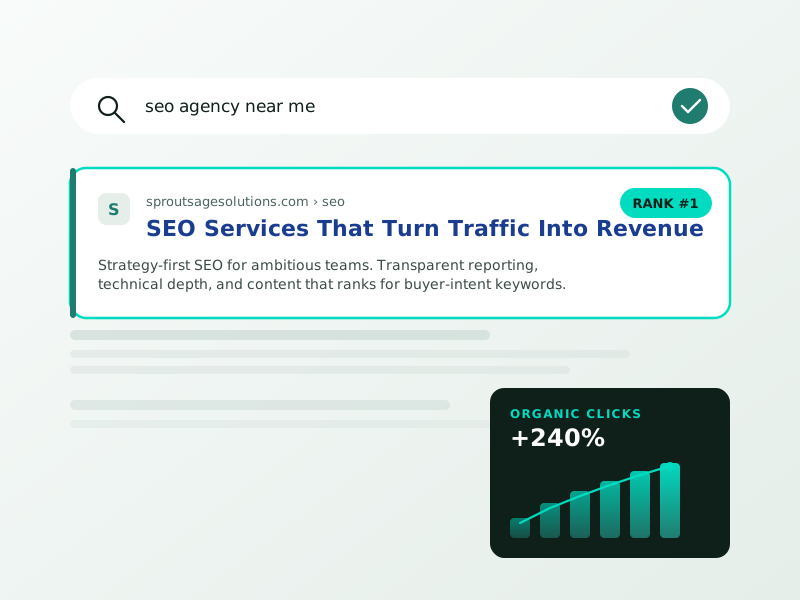
Content marketing for small business, minus the fluff. 10 plays that drive real leads on a $500/month budget. Free 30-min audit.
Content marketing for small business used to mean “start a blog, post twice a week, wait.” In 2026 that approach fails. AI Overviews absorb informational queries, attention spans shrink, and costs climb. What works now is narrower, deeper, and more commercial.
This playbook gives you 10 plays that still pay back within 6 to 12 months on a realistic small-business budget.
In this guide
- The New Reality
- Play 1: Start With Commercial Intent Keywords
- Play 2: Build Topic Clusters Not Random Posts
- Play 3: Publish Less, Edit More
- Play 4: Answer Specific Questions
- Play 5: Include Proof and Examples
- Play 6: Repurpose Ruthlessly
- Play 7: Update Old Posts
- Play 8: Optimize for AI Citations
- Play 9: Distribution Matters More Than Ever
- Play 10: Measure Commercial Outcomes
- A Realistic Content Calendar for $500/Month Budget
- Tools That Pay for Themselves
- Common Content Marketing Mistakes
- Tying Content Into Your Broader Strategy
- FAQ
The New Reality
- 58 percent of Google searches end without a click (AI Overviews, featured snippets, People Also Ask)
- Informational queries lose traffic fastest
- Commercial and transactional queries still convert at 2020 rates
- Quality threshold for ranking has risen sharply
- Have clearer ROI
- Are less competitive from AI Overviews
- Convert 10 to 50x better than informational content
- Sales call recordings
- Support tickets
- Reddit threads in your niche
- “People Also Ask” on target keywords
- 3 LinkedIn posts
- 5 tweets
- 1 YouTube short script
- 1 email newsletter
- Supporting slides for a webinar
- Source for a guest post
- Clear, structured answers (H2 questions, concise H3 answers)
- Specific data and numbers
- Recent dates (AIs prefer fresh)
- Schema markup (Article, FAQ, HowTo)
- Email your list the day it publishes
- Post excerpts on LinkedIn with a link
- Share in relevant communities (Slack, Reddit, forums; only where welcome)
- Pitch to 3 to 5 journalists or podcasters per month
- Leads or sales attributed to organic content
- Email signups from blog
- Time from first visit to paid customer
- 2 pillar or commercial posts per month (external writer at $150-250 each)
- 1 content update per month
- 1 case study or customer story per quarter
- Distribution time: 2 hours per week
- Google Search Console (free)
- GA4 (free)
- A keyword research tool ($99-200/month, Semrush or Ahrefs)
- A writing tool (Claude or ChatGPT at $20/month, as editor not writer)
- A grammar tool (Grammarly $12/month)
- Writing what you want to write, not what customers search. Always match keyword research.
- Publishing once and forgetting. Distribution is 50 percent of the work.
- Chasing word count over quality. A 1,000-word post with insight beats a 3,000-word post with fluff.
- Ignoring internal linking. Every post should link to 2 to 4 others.
- Outsourcing to cheap writers. $30 posts read like $30 posts.
Writing 500-word “top 10 tips” posts no longer works. Writing nothing is worse. The middle path is sparse, strong content aimed at commercial intent.
Play 1: Start With Commercial Intent Keywords

Instead of “what is SEO,” target “best SEO agency Denver” or “SEO pricing for law firms.”
Commercial intent pages:
Our keyword research for beginners post covers finding these.
Play 2: Build Topic Clusters Not Random Posts
⚡ 2-minute scorecard · instant result
How strong is your lead engine?
Answer 5 quick questions. Get your score + the top fixes, free.
1. Do you track which source every lead comes from?
2. Do you respond to new leads in under 5 minutes?
3. Do you have a CRM that catches every inquiry?
4. Do you run a follow-up / nurture sequence?
5. Is your site built to convert, not just inform?
One pillar page (broad topic) + 5 to 8 cluster posts (specific subtopics), all interlinked. Tells Google you are an authority on the topic, concentrates link equity, and serves users better.
Example pillar: “Small Business SEO Guide” Cluster posts: on-page checklist, keyword research, site audit, local SEO, content strategy.
Play 3: Publish Less, Edit More
Two well-researched 1,500-word posts per month outperform eight thin 600-word posts. Every post you publish should solve a problem, name specific numbers, and include original insight.
AI-generated fluff ranks nowhere in 2026. Google’s quality classifiers detect it.
Play 4: Answer Specific Questions

Mine your customer conversations:
Every real question is a blog post that will drive qualified traffic.
Play 5: Include Proof and Examples
Stock advice loses. Specific examples win.
Bad: “Make your pages fast.” Good: “We cut this client’s LCP from 4.8s to 1.9s by lazy-loading 34 below-fold images and switching to a Brotli-enabled CDN.”
Pricing, timelines, screenshots, case studies. Specifics build authority.
Play 6: Repurpose Ruthlessly
One 1,500-word post becomes:
This is not cheating; it is respecting your own effort. The post took 6 hours to write; the spinoffs take 30 minutes each.
Play 7: Update Old Posts
Updating a ranking post to 2026 standards typically lifts traffic 30 to 80 percent. Cheaper than writing new.
Identify candidates: posts ranking positions 5 to 20 with stable monthly traffic. Refresh, add new sections, update stats, republish with a fresh date.
Play 8: Optimize for AI Citations
Chatbots (ChatGPT, Perplexity, Google AI Overviews) are citing content. To be cited:
Our AI Overview optimization post goes deep.
Play 9: Distribution Matters More Than Ever
Publishing a post and waiting for Google is not a strategy. Distribute actively:
10 hours on content + 2 hours on distribution outperforms 12 hours on content alone.
Play 10: Measure Commercial Outcomes
Vanity metrics (traffic, shares) are not outcomes. Track:
If 6 months in you cannot tie content to revenue, change approach. Use our SEO ROI calculator to model the funnel.
A Realistic Content Calendar for $500/Month Budget
Total: ~$500/month cash plus 8 to 12 hours of internal time.
12-month outcome for a typical small business: 3x organic traffic, 2x qualified leads. Not overnight, compounding.
Tools That Pay for Themselves
Total: under $250/month in tools. Skip shiny new AI content platforms.
Common Content Marketing Mistakes
Tying Content Into Your Broader Strategy
Content marketing works best inside a broader SEO + CRO + distribution machine. Read our EEAT for small business SEO guide for the trust-signal side. Our search engine optimisation services bundle content strategy with technical SEO for businesses that want outcomes, not just output.
Use our word counter while writing to hit target lengths without bloating.
FAQ
How many blog posts per month do I need? Two well-researched posts beat eight thin ones in 2026. Publishing cadence matters less than quality and topical authority. A niche site with 20 excellent posts often outperforms a generic site with 200 average posts. Focus on depth and updates, not quantity.
How long until content marketing pays off? Expect 6 to 12 months before compounding traffic and leads. Quick wins happen at 90 days for commercial-intent keywords with low competition. Informational content takes longer and pays less in 2026 because of AI Overviews. Plan for a year minimum.
Should I use AI to write my blog posts? Use AI as editor, not writer. AI-first drafts without heavy human editing read like AI and rank poorly. AI is great for outlining, proofreading, summarizing research, and suggesting angles. Final voice and examples need real human input from someone with real experience.
Do I need to write long-form content to rank? No. Match length to intent. A 700-word precise answer beats a 3,000-word essay when the user wants a quick answer. Check top-ranking competitors on your target query and aim for similar thoroughness, not arbitrary word counts.
Want a content plan built around your real commercial opportunities? Book a free 30-minute consultation and we will map your next 6 posts live.
Ready to grow faster?
Free 30-minute strategy call. No pitch, just answers.
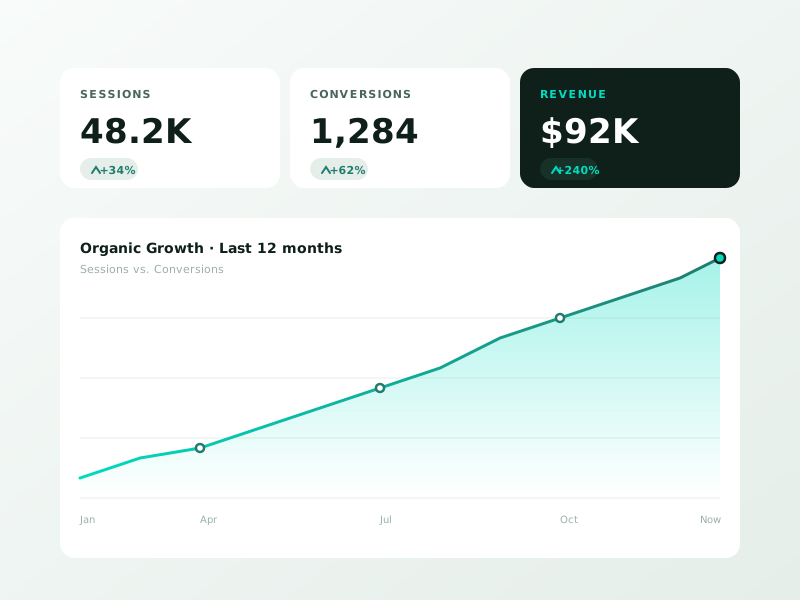
Ready to turn this into real bookings?
Free 30-min audit. We review your current setup and give you 3 specific wins — whether we work together or not. Starts at 0/month. No contract. One medspa per market.
Book My Free Audit →No credit card. No pitch. No 12-month lock-in.



