

Small Business SEO Checklist 2026: The 27-Point Plan That Actually Works
The practical small business seo checklist playbook top agencies actually use. Real tactics, real numbers, zero fluff. Read in 7 min.
Table of Contents
If you’ve ever typed “how to improve my website SEO” into Google, you’ve been buried in 6,000-word guides that tell you everything and prioritize nothing. This is the opposite.
Below is a 27-item checklist, in priority order. Start at the top, work down, and you will see real ranking movement within 60 days. No fluff. No “it depends.” Just the things that actually move the needle for small businesses in 2026.
Part 1: Foundation (Week 1)
These are non-negotiable. If any of them are missing, nothing else matters.
1. Verify the site loads over HTTPS. Visit your site. If the padlock icon is missing or broken, your hosting company can install a free Let’s Encrypt certificate in under an hour. Until this is fixed, Google penalizes every page.
2. Check mobile-friendliness. Run your homepage through Google’s Mobile-Friendly Test (search.google.com/test/mobile-friendly). If it fails, the fix is usually a responsive theme, not a deep rebuild.
3. Install Google Search Console + Google Analytics 4. These are the only two tools you actually need to start. Search Console shows what Google sees. GA4 shows what visitors do. Free, 20 minutes to set up, everything else in this list depends on having them.
4. Submit your sitemap to Search Console. Most WordPress SEO plugins (Rank Math, Yoast) generate it automatically at `yoursite.com/sitemap.xml`. Submit it once. Google will re-crawl whenever you publish new content.
5. Fix robots.txt. Yours should look like this for a standard WordPress site:
“`
User-agent: *
Allow: /
Disallow: /wp-admin/
Allow: /wp-admin/admin-ajax.php
Sitemap: https://yoursite.com/sitemap.xml
“`
If you’re blocking major crawlers like Ahrefs or SEMrush, remove those blocks, they don’t hurt your SEO, and they only prevent YOU from seeing how you’re performing.
6. Check for a Google penalty or security issue. Search Console → Security & Manual Actions. If either tab shows a warning, fix it before doing anything else. Nothing you do will rank until penalties are lifted.
Part 2: Technical Hygiene (Week 2)
7. Run a full crawl with Screaming Frog (free up to 500 URLs). Look for: 4xx errors, 5xx errors, redirect chains longer than 1 hop, duplicate titles, missing metas. Fix them all.
8. Core Web Vitals. Run PageSpeed Insights on your 5 most-visited pages. Target: LCP under 2.5s, CLS under 0.1, INP under 200ms. On WordPress, 80% of speed issues are solved by: (a) a caching plugin (LiteSpeed if you’re on LiteSpeed hosting, WP Rocket if you’re on anything else), (b) compressing images via ShortPixel or Smush, (c) removing unused plugins.
9. Canonical tags on every page. Your SEO plugin should handle this automatically. Verify by viewing page source and searching for `rel=”canonical”`, it should be present and point to the self URL (unless it’s a duplicate of another page, in which case it should point to the canonical).
10. Schema markup for Organization + Service. Use WPCode or your SEO plugin to add structured data. At minimum: Organization schema on every page, Service schema on each service page. Test in validator.schema.org.
11. XML sitemap hygiene. Make sure: (a) Only the sitemap you want Google to crawl is submitted. (b) No staging pages, no author archives, no date archives, no tag pages unless they’re valuable. In Rank Math: SEO → Titles & Meta → turn OFF sitemaps for low-value post types.
12. 404 errors. Search Console → Coverage report. For every “Not found (404)” in your sitemap, either: restore the page, 301-redirect the URL to the best replacement, or remove it from the sitemap.
Part 3: On-Page (Week 3)
⚡ 2-minute scorecard · instant result
How healthy is your SEO right now?
Answer 5 quick questions. Get your score + the top fixes, free.
1. Are most of your key pages actually indexed in Google?
2. Do you rank on page 1 for at least a few buyer keywords?
3. Is your technical SEO (speed, errors, mobile) clean?
4. Have you updated your top pages in the last 90 days?
5. Are you earning new backlinks/mentions over time?
13. One focus keyword per page. Every service page, blog post, and landing page needs one primary keyword it’s targeting. Not “SEO”, too broad. Something like “small business SEO checklist” or “SEO services for law firms.”
14. Title tag under 60 characters. Include the focus keyword. Put the most important words first. Example: `Small Business SEO Checklist 2026 | Sprout Sage`, not `Welcome to our SEO services page for businesses`.
15. Meta description under 156 characters. Include the focus keyword. Make it a promise a human would click. Example: `27 specific SEO actions in priority order. Start at the top, work down. Real ranking movement within 60 days.`
16. H1 contains the focus keyword. One H1 per page. Make it a clear, benefit-driven headline, not a label like “About Us.”
17. H2s cover the subtopics people search for. Use tools like AlsoAsked or Google’s “People also ask” to find related questions. Make each an H2.
18. Content depth ≥ 1,200 words for commercial pages, ≥ 1,800 for pillar content. Not because word count ranks, but because short content doesn’t cover the topic completely enough to satisfy Google’s intent matching.
19. Internal linking. Every service page should link to at least 3 related blog posts. Every blog post should link to at least 1 service page. Use descriptive anchor text, not “click here.”
20. Image alt text. Every image gets a short, descriptive alt. If the image is decorative, `alt=””` is correct (not “image1.jpg”).
Part 4: Local SEO (Week 4, if you're local)
21. Google Business Profile. Claim it. Fill out every field. Upload 10+ photos. Enable messaging. Post weekly updates. This alone drives more traffic for most local businesses than organic search does.
22. NAP consistency. Name, Address, Phone, identical across GBP, your website, and every online directory. Inconsistent NAPs confuse Google and hurt local rankings.
23. Local schema. Add LocalBusiness schema to your contact page with the exact address, hours, and phone that match your GBP.
24. Citations. List your business on BrightLocal’s top-50 directories for your country. Don’t pay for a “2,000 directory submission” service, most are spam.
25. Reviews. Ask every happy customer for a Google review. Reply to every review, positive or negative. Target: 25+ reviews with 4.5+ stars.
Part 5: Content + Authority (Ongoing)
26. Publish one in-depth post per week. Minimum 1,500 words, answering a specific question your prospects actually ask. Not generic “top 10” fluff, specific, actionable, keyword-targeted pieces.
27. Build 2-3 quality backlinks per month. Guest posts on relevant industry sites, directory listings, partner co-marketing, HARO responses. Quality beats quantity every time. One DR-60 link is worth 100 spam links.
What happens if you actually do all 27
Most small businesses see:
– 30 days: Technical fixes compound. Crawl errors drop. Core Web Vitals improve. Indexation cleans up.
– 60 days: Long-tail keywords start ranking. Organic impressions climb 30–60%.
– 90 days: Commercial keywords move into top-20. Click-through rate improves from schema + better titles.
– 6 months: Competitive keywords reach top-10. Organic revenue starts compounding.
This isn’t theoretical, it’s the playbook we’ve run on 30+ small business sites. The ones that execute the full list see 2–5× traffic growth in 12 months. The ones that pick and choose usually plateau.
The shortcut most small businesses miss
Most of this list is technical execution. The hardest part for most small business owners is not *knowing* what to do, it’s having the time and focus to actually do it. If that’s where you’re stuck, we offer a free SEO consultation where we’ll audit your site against this checklist and tell you exactly which 5 items will move the needle fastest for your specific business.
No pitch, no obligation, just a real audit and specific next steps.
—
Related reading:
– SEO Services That Deliver Rankings, Traffic, and Paying Customers
– Websites That Load Fast, Rank Well, and Convert Visitors
– How to Build an SEO Roadmap That Drives Performance
Ready to grow faster?
Get a free 30-minute strategy call. No pitch, just answers.
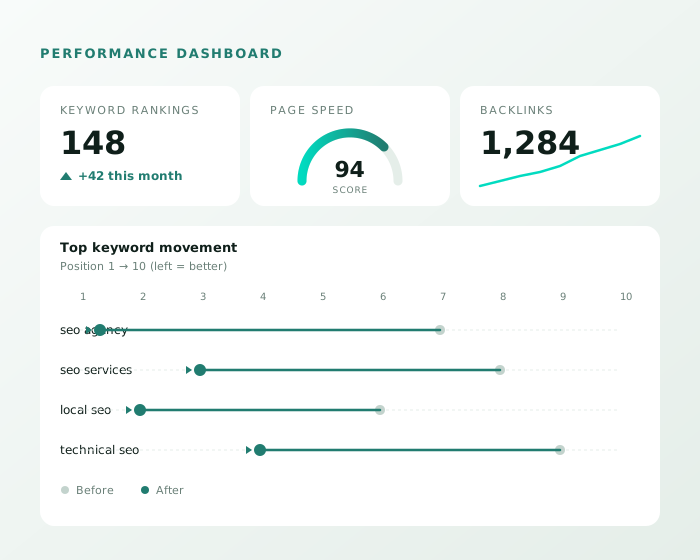
Ready to turn this into real bookings?
Free 30-min audit. We review your current setup and give you 3 specific wins — whether we work together or not. Starts at 0/month. No contract. One medspa per market.
Book My Free Audit →No credit card. No pitch. No 12-month lock-in.



