

Ecommerce SEO Checklist 2026 – 42 Fixes That Actually Drive Sales
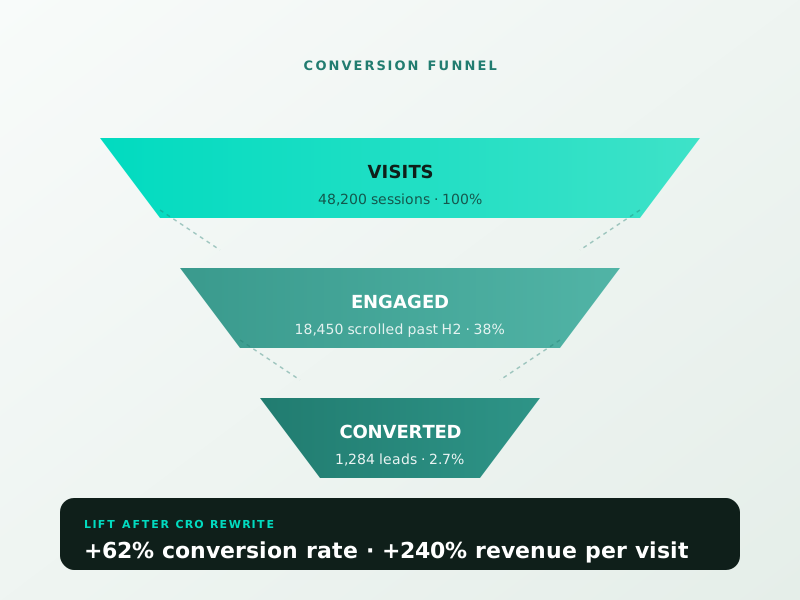
The practical ecommerce seo checklist 2026 playbook top agencies actually use. Real tactics, real numbers, zero fluff. Read in 7 min.
Table of Contents
- Technical Foundation (10 Fixes)
- Product Page Optimization (8 Fixes)
- Category Page Optimization (6 Fixes)
- Content and AI Overviews (7 Fixes)
- On-Page and Internal Linking (5 Fixes)
- Schema and Structured Data (4 Fixes)
- Reviews, UGC, and Trust (3 Fixes)
- Competitive and Keyword Research (3 Fixes)
- Brand and Conversion (2 Fixes)
- Measurement and Iteration
- Platform-Specific Considerations
- Seasonal and Launch Timing
- International and Multi-Region Stores
- Ready to Fix Your Store's SEO
- Keep reading
- Ready to turn traffic into revenue?
The ecommerce SEO checklist 2026 looks different from the 2022 version because Google’s AI Overviews, Search Generative Experience, and tightened product schema now decide who gets clicks. Shopify and WooCommerce stores that still rely on a 2023 playbook are watching Amazon and TikTok Shop eat their traffic. This year’s winners are the ones treating category pages like cornerstone content, shipping schema like inventory data, and page speed like a conversion lever.
Here are the 42 fixes we work through with every ecommerce client, prioritized by impact.
Technical Foundation (10 Fixes)
Get these right first. Nothing else compounds if the plumbing is broken.
- Force HTTPS site-wide and fix every mixed-content warning
- Submit a clean XML sitemap that excludes out-of-stock, noindex, and canonical duplicates
- Set canonical tags on every faceted URL (color, size, sort filters)
- Ensure Core Web Vitals are green on mobile: LCP under 2.5s, INP under 200ms, CLS under 0.1
- Lazy-load below-fold images and serve WebP or AVIF
- Remove render-blocking JavaScript from above-the-fold content
- Use hreflang correctly if you sell in multiple regions (watch for return-tag errors)
- Fix crawl depth – no important product should be more than 3 clicks from the home page
- Add pagination controls with self-referencing canonicals (rel=next/prev is dead, but logical structure still matters)
- Set a robots.txt that blocks cart, checkout, wishlist, and internal search result pages
- Write 300 to 600 words of unique description per product (no manufacturer boilerplate)
- Add a dedicated FAQ section with 4 to 6 real buyer questions per product
- Implement Product schema with price, availability, review count, aggregate rating, and shippingDetails
- Show live stock status (“Only 3 left”) – this pulls into AI Overviews
- Upload 6 to 10 images including lifestyle shots and scale reference
- Add a 30 to 60 second product video with VideoObject schema
- Show shipping time by zip code above the fold
- Display trust badges, return policy, and warranty right next to the buy button
- Add 200 to 400 words of unique intro content above the product grid
- Include a buying guide section below the fold (size, material, use case)
- Link to 3 to 5 related subcategories and 2 to 3 blog posts
- Use CollectionPage schema
- Sort products by bestseller or conversion rate, not alphabetically
- Show filters as crawlable links where they target real queries (e.g. /mens-running-shoes/waterproof/)
- Publish comparison posts (“Product A vs Product B”) with clear verdicts
- Build buying guides structured as question-and-answer, with 40 to 60 word answers under each H2
- Add HowTo schema for any content that walks through a process
- Use tables for feature comparisons – AI Overviews extract tables cleanly
- Include concrete data points: prices, weights, measurements, warranty lengths
- Update high-traffic posts every 90 days with a visible “Updated” date
- Link from guides to category pages using natural anchor text
- Every product page should link to its parent category and 4 related products
- Every blog post should link to at least 2 category pages and 1 product page
- Use descriptive anchor text – “men’s waterproof running shoes” beats “click here”
- Build topic clusters: one pillar category + 6 to 10 supporting blog posts
- Audit orphan pages monthly and internally link them within 30 days
- Product schema with all required and recommended fields
- Organization schema on the homepage with logo, sameAs, and contactPoint
- BreadcrumbList schema on every category and product page
- Review and AggregateRating schema pulled from verified reviews only (Google penalizes fake review markup hard in 2026)
- Collect verified reviews via Shopify Reviews, Judge.me, Yotpo, or Trustpilot
- Show customer photos on product pages – UGC lifts conversion 10 to 25 percent
- Syndicate reviews from one product variant to all variants so new colors launch with social proof
- Identify the top 10 competitors per category and track their new pages weekly
- Build keyword clusters around commercial intent, not search volume alone
- Target “best [product] for [use case]” long-tail terms with dedicated landing pages
- A clean, recognizable brand identity that signals trust the moment the page loads
- Fast, distraction-free graphic design on product imagery, ads, and packaging so assets work across Google Shopping, Instagram, and TikTok Shop
- Organic revenue by category (not just sessions)
- Product page click-through rate from Search Console
- Share of AI Overview citations in your top 20 terms
- Cart abandonment on organic sessions vs paid
If you fail Core Web Vitals, you lose 5 to 15 percent of conversions before SEO even enters the picture. Fix speed first.
Product Page Optimization (8 Fixes)
Product pages drive the revenue. Most are dramatically underwritten.
Google’s 2026 shopping updates pull structured shipping data directly into the product carousel. If you do not provide it, a competitor who does will show up instead.
Category Page Optimization (6 Fixes)
⚡ 2-minute scorecard · instant result
Is your store leaving money on the table?
Answer 5 quick questions. Get your score + the top fixes, free.
1. Do you track ROAS against your true margin (not revenue)?
2. Do you have an abandoned-cart recovery flow live?
3. Is product + review schema on your product pages?
4. Does your store load fast on mobile?
5. Does email/SMS drive 20%+ of your revenue?
Category pages are the single biggest missed opportunity in most stores. They should rank for head terms and convert browsers to buyers.
A well-built category page can do the work of 50 product pages combined. Treat it like a landing page for a commercial keyword.
Content and AI Overviews (7 Fixes)
Half of high-intent ecommerce queries now trigger an AI Overview. You want to be cited inside it.
AI Overviews favor sources that answer directly, cite data, and structure information clearly. Fluffy blog posts are invisible. Specific, dense, well-structured ones get cited.
On-Page and Internal Linking (5 Fixes)
Internal links control how PageRank flows through your store. Most stores leak authority into footer and breadcrumb links while starving the pages that actually sell.
If the architecture feels wrong, a sitewide information architecture review from a qualified UI/UX services partner usually pays for itself in one quarter.
Schema and Structured Data (4 Fixes)
Validate everything in Search Console’s rich results report. Warnings become errors fast.
Reviews, UGC, and Trust (3 Fixes)
Store pages without reviews lose to competitors with them, regardless of backlink profile. It is that simple.
Competitive and Keyword Research (3 Fixes)
A single “best running shoes for flat feet” page can outrank a generic category for its target audience. Specificity wins.
Brand and Conversion (2 Fixes)
SEO traffic means nothing if it bounces. Two levers lift ecommerce conversion more than anything else in 2026:
Brand-led stores convert 2 to 4x better on paid and organic traffic than generic ones. Invest in the brand layer alongside the SEO layer, or you will out-traffic your ability to close.
Measurement and Iteration
Track these monthly:
Platform-Specific Considerations
Each major ecommerce platform has its own quirks in 2026. Shopify finally fixed native hreflang support with Markets, but still limits robots.txt control – be careful with collection pagination bleeding into the index. WooCommerce gives full control but requires you to actively manage server performance, plugin bloat, and schema output. BigCommerce handles most technical basics well but struggles with advanced faceted nav. Magento and Adobe Commerce remain the most flexible but the most expensive to maintain. Pick the platform that matches your team’s technical capacity, not the one with the best marketing.
Seasonal and Launch Timing
Push major SEO changes at least 60 days before a peak season, never during it. For US retailers, that means July and early August work for Black Friday prep. UK and EU follow similar cadence. Israeli retailers should plan around the Tishrei holiday window. Product launches should be supported by a dedicated landing page published 30 days in advance, internally linked from category pages and the blog, and backed by schema that can populate Google Shopping and AI Overviews from day one.
Get a free 30-minute growth audit.
International and Multi-Region Stores
If you sell across US, UK, Canada, and Israel, you need distinct subfolders or subdomains, correct hreflang with return tags, localized currency and shipping, and ideally localized content rather than machine-translated copy. Google ranks geo-appropriate pages for geo-appropriate queries. A single English-US store trying to serve UK customers will lose to a British competitor with a proper .co.uk presence every single time.
Ready to Fix Your Store's SEO
If you want a prioritized audit of your ecommerce site against this checklist – with revenue projections, timeline, and competitor gaps – book a free consultation and we will run a live walkthrough of your top 5 category pages, flag the highest-impact fixes, and show you what your competitors are already winning that you are leaving on the table.
Sprout Sage Solutions
Newsletter
Get 1 growth tip a week.
No fluff. No 10-email sequences. Just one idea that moves a metric.
Keep reading
Small Business SEO Checklist 2026: The 27-Point Plan That Actually Works
Brand Identity Checklist for Startups – 2026 Launch Guide
Technical SEO Audit Template 2026 – 58-Point Checklist That Works
Ready to turn traffic into revenue?
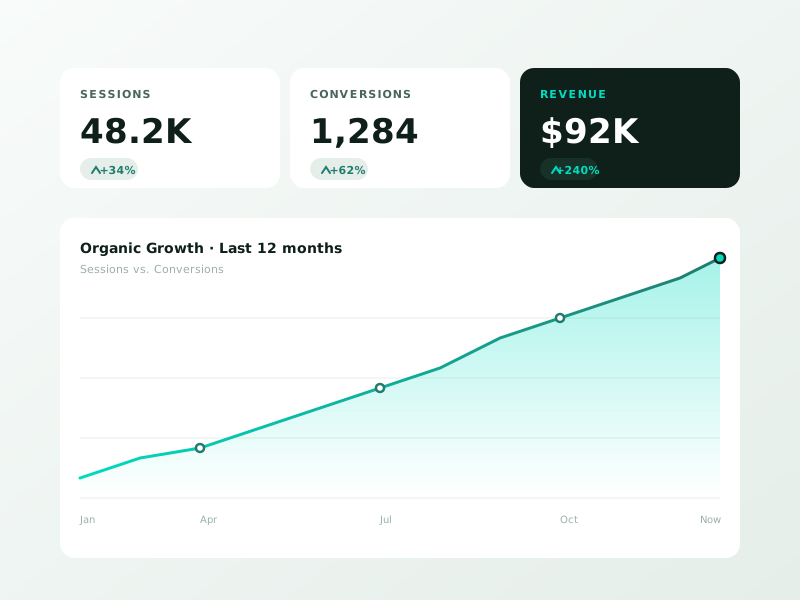
Ready to turn this into real bookings?
Free 30-min audit. We review your current setup and give you 3 specific wins — whether we work together or not. Starts at 0/month. No contract. One medspa per market.
Book My Free Audit →No credit card. No pitch. No 12-month lock-in.



