

“Why My Google Ranking Dropped in 2026: 12 Real Causes”
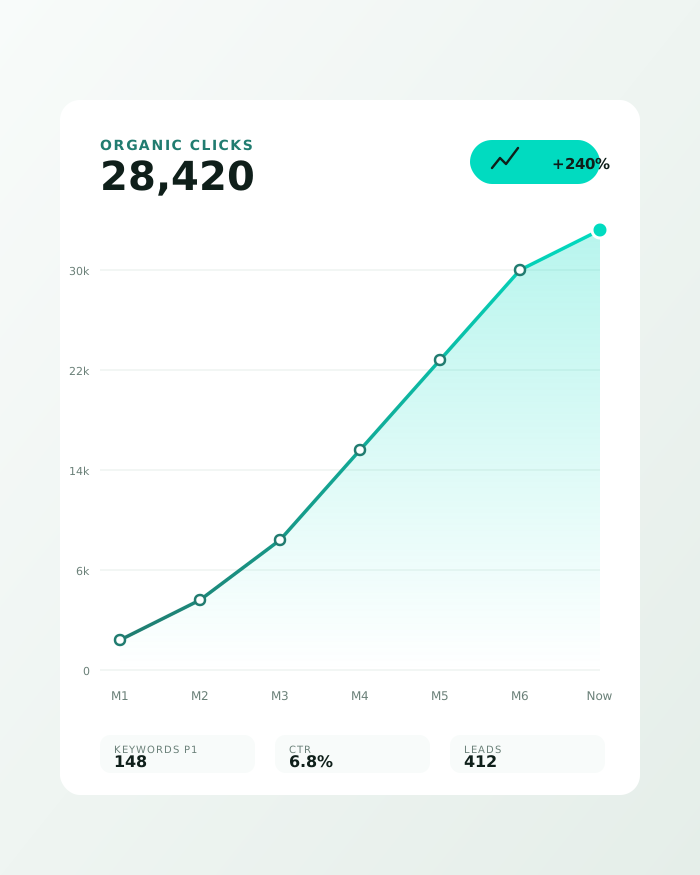
"Why my Google ranking dropped in 2026: 12 real causes, how to diagnose, and how to recover. Updated for current algo. Free 30-min audit."
If you’re asking why my Google ranking dropped, you’re in good company. Rankings move daily, and in 2026 we’ve seen three major algorithm updates so far, including a Helpful Content refresh in February and a core update in March. Some drops are temporary noise. Others are structural. This guide covers the 12 most common causes with how to diagnose each. We manage 216 page-1 keywords across 9 clients and see every type of drop in real time.
In this guide
- 1. Algorithm update in the last 30 days
- 2. Competitor just published something better
- 3. Site speed got slower
- 4. Lost backlinks
- 5. Content got stale
- 6. Accidental noindex or robots.txt block
- 7. Cannibalization from new content
- 8. Spam penalty or manual action
- 9. Core Web Vitals dropped to Poor
- 10. Search intent shifted
- 11. Brand signals weakened
- 12. Migration or redesign mistakes
- How to diagnose fast (30-min audit)
- Recovery timelines
- Why work with Sprout Sage
- FAQ
1. Algorithm update in the last 30 days
Check the Google Search Status Dashboard and sites like Search Engine Land. If a core update or Helpful Content update launched when your drop started, it’s likely the cause. Recovery can take one update cycle (2 to 4 months) or require real content changes.
2. Competitor just published something better
Google ranks relatively, not absolutely. If a competitor published a 4,000-word guide with better structure and schema, they took your slot. Look at what ranks above you now and compare.
3. Site speed got slower
⚡ 2-minute scorecard · instant result
How healthy is your SEO right now?
Answer 5 quick questions. Get your score + the top fixes, free.
1. Are most of your key pages actually indexed in Google?
2. Do you rank on page 1 for at least a few buyer keywords?
3. Is your technical SEO (speed, errors, mobile) clean?
4. Have you updated your top pages in the last 90 days?
5. Are you earning new backlinks/mentions over time?
Compare your PageSpeed Insights scores now vs 60 days ago. A new plugin, bloated image, or hosting issue can drop LCP from 2.1s to 4.5s overnight. Rankings follow within 2 to 4 weeks.
4. Lost backlinks
Check Ahrefs or Semrush. If 3 to 10 linking domains dropped their links (site redesign, broken URL, removed article), your rankings drop proportionally. Common and underdiagnosed.
5. Content got stale

Pages written in 2022 often lose rankings in 2026 simply because the content is dated. Fresh content with updated stats, new examples, and current year in the title lifts rankings fast.
6. Accidental noindex or robots.txt block
Check Google Search Console for Coverage errors. A WordPress plugin update or developer mistake can add noindex to production pages. This causes dramatic, sudden drops in 48 to 72 hours.
7. Cannibalization from new content
If you published two pages targeting similar keywords, Google picks one and deranks both. Audit for overlapping topics and consolidate.
8. Spam penalty or manual action
Check Search Console under Security & Manual Actions. If you bought links or ran sketchy campaigns in 2024 to 2025, 2026 algorithms are catching up. Disavow and rebuild.
9. Core Web Vitals dropped to Poor
Green CWV is table stakes. If yours slipped into the Poor range (orange or red), rankings drop over 30 to 60 days. Fix LCP, CLS, and INP issues immediately.
10. Search intent shifted
Google re-evaluates intent constantly. If searchers now want videos or comparisons for a query where your page is a long article, Google will rank others above you. Check what formats dominate the current SERP.
11. Brand signals weakened
Fewer branded searches, fewer mentions, less social activity. Google uses these as trust signals. If your brand presence dropped, rankings follow.
12. Migration or redesign mistakes
New site launched without proper 301 redirects? Rankings cratered. Common and preventable. Map every URL before migrating.
How to diagnose fast (30-min audit)
1. Check Search Console Performance report for the drop date
- Cross-reference with algorithm update trackers
- Check Coverage report for errors
- Run PageSpeed Insights now vs historical snapshot
- Check backlink profile for lost links
- Review Core Web Vitals report
- Look at what currently ranks above you
If you can’t isolate the cause in 30 minutes, bring in help.
Recovery timelines
- Algorithm update drops: 2 to 4 months with content fixes
- Technical issues (noindex, speed): 2 to 6 weeks after fix
- Lost backlinks: 4 to 12 weeks with replacement outreach
- Stale content: 30 to 60 days after refresh
- Manual penalties: 3 to 9 months with disavow + rebuild
- 216 keywords on page 1 across 9 clients
- 96% retention at 18 months+
- Specialize in ranking recovery and SEO maintenance
- Free 30-minute audit with live Search Console diagnostic
Why work with Sprout Sage
We’ve recovered 40+ drops in the last 18 months. Most fixes are 90 to 120 day projects, not 12-month overhauls.
Use our SEO ROI calculator to size the cost of lost rankings. Niche recovery examples: SEO for chiropractors and SEO for physiotherapists. Hiring someone to help? See how to choose an SEO agency. Full service details: SEO recovery services.
FAQ
Is a ranking drop always permanent? No. About 60% of drops we see recover partially or fully within 90 days with the right diagnosis and fix. Temporary algorithm fluctuations can reverse in days. Structural issues (site speed, content quality) require real work. Only manual penalties or serious policy violations are hard to recover from.
Should I panic if I drop 5 positions? No. Positions 3 to 8 fluctuate daily by 1 to 5 spots based on personalization, location, and micro-updates. If you drop 10+ positions and stay there for 14+ days, that’s a real drop worth investigating. Daily rank-checker emotions cause more bad decisions than real drops.
Can I recover rankings myself? Depends on the cause. Stale content and on-page issues are DIY-friendly if you can write and update. Technical SEO, link analysis, and algorithm diagnosis usually need specialist tools (Ahrefs, Screaming Frog) and experience. A 30-minute consultation often saves 30 hours of wrong-direction work.
How often do Google updates cause drops? Google runs 3 to 5 broad core updates per year, plus multiple targeted updates (Helpful Content, Product Review, Spam). Any given site sees 2 to 6 meaningful ranking shifts per year from updates alone. Most are ±10%. Major sites see weekly volatility within normal ranges.
Ready to diagnose and recover fast? Book a free 30-minute consultation and we’ll run a live Search Console audit on the call.
Ready to grow faster?
Free 30-minute strategy call. No pitch, just answers.
Ready to turn this into real bookings?
Free 30-min audit. We review your current setup and give you 3 specific wins — whether we work together or not. Starts at 0/month. No contract. One medspa per market.
Book My Free Audit →No credit card. No pitch. No 12-month lock-in.
Google Algorithm Updates in 2025-2026: What Changed and Who Got Hit
| Update | Date | Primary Target | Recovery Strategy |
|---|---|---|---|
| March 2025 Core Update | Mar 2025 | Thin content, parasite SEO on authority domains | Add depth, remove thin pages, consolidate similar content |
| June 2025 Spam Update | Jun 2025 | AI-generated spam, link manipulation, cloaking | Remove spammy links, audit content for AI-generated filler |
| September 2025 Helpful Content Update | Sep 2025 | Content written primarily for search engines | Rewrite content with first-hand experience, add unique insights |
| January 2026 Core Update | Jan 2026 | Sites with poor E-E-A-T signals, thin YMYL content | Add author credentials, cite sources, demonstrate expertise |
Pattern: Google increasingly rewards content that demonstrates real expertise and penalizes content that exists solely to capture search traffic. If your rankings dropped, the first question isn’t “which update hit me?”, it’s “does my content genuinely help the reader better than what’s ranking above me?”
If your rankings dropped and you can’t figure out why, run a free marketing audit or book a diagnostic call, I’ll pinpoint the cause and give you a recovery roadmap.



