

Plastic Surgeon Medspa Marketing in 2026: Adding Non-Surgical Services Without Diluting Your Surgical Brand
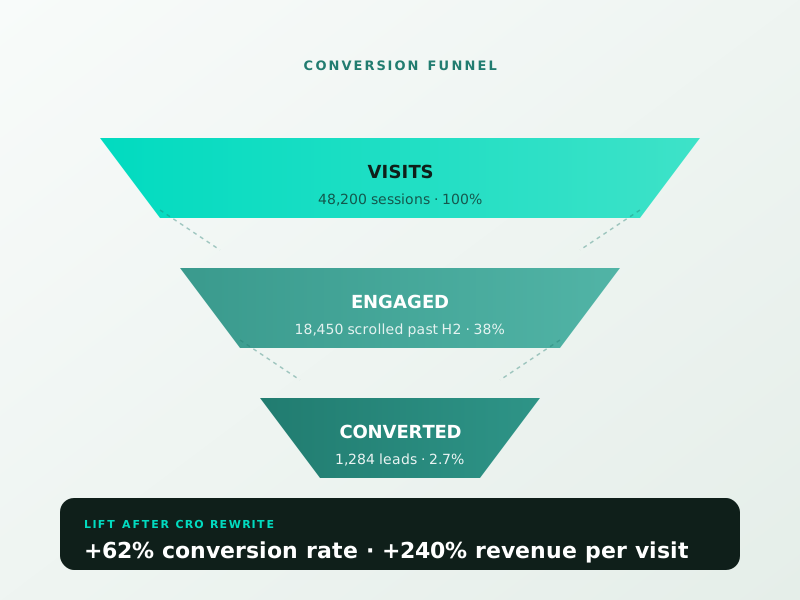
Plastic surgeons adding medspa services face a unique marketing challenge: their surgical brand attracts a different patient than their aesthetic medicine services, and marketing both incorrectly can undermine both. Here's how to add injectables, RF, and non-surgical services without diluting your surgical brand.
Table of Contents
- 1. Why Plastic Surgeons Add Medspa Services
- 2. The Brand Risk: Why This Goes Wrong
- 3. Brand Architecture Options
- 4. Patient Migration Strategy: Introducing Surgical Patients to Non-Surgical Services
- 5. New Patient Acquisition for the Medspa Division
- 6. Google Ads: Campaign Architecture for Dual Service Lines
- 7. SEO: Surgical and Non-Surgical Site Architecture
- 8. Social Media: Featuring Non-Surgical Without Appearing to Pivot
- 9. Staffing Signal: Surgeon vs. Delegated Injector
- 10. Pricing Strategy: Do Not Discount to Acquire
- 11. Frequently Asked Questions
The plastic surgeon’s entry into non-surgical aesthetic services is a natural business evolution, but it carries marketing risks that most practices underestimate. The surgical brand you have built is valuable precisely because it signals a specific level of clinical excellence, case complexity, and patient outcome. That brand attracts patients willing to pay $15,000–$60,000 for surgery. Marketing Botox and laser treatments from the same platform, without a deliberate strategy, can undermine the positioning you’ve spent years building.
This is not a theoretical concern. Plastic surgeons who market their non-surgical services alongside their surgical work in an undifferentiated way, the same social media feed, the same website pages, the same promotional language, consistently report that their high-value surgical referrals soften. The surgical patient begins to wonder whether the practice has changed focus. The aesthetic medicine patient, meanwhile, compares you to standalone medspas and wonders why you are more expensive.
The goal of this guide is to help plastic surgeons add and grow non-surgical services profitably without creating this brand confusion, and to build the marketing architecture that turns the medspa division into a patient pipeline for surgery rather than a distraction from it.
—
1. Why Plastic Surgeons Add Medspa Services
There are four legitimate strategic reasons for a plastic surgery practice to add non-surgical aesthetic services. Understanding which of these is your primary motivation should inform how you structure and market the service line.
1. Surgical Patient Pipeline: Non-surgical patients who experience results, build trust with your team, and evolve in their aesthetic goals represent the highest-quality surgical leads available. A facelift candidate who has been a Botox patient for four years is a materially different consult than a cold surgical inquiry from the internet. The non-surgical practice is a patient incubator.
2. Revenue Diversification: Surgical revenue is lumpy, it depends on OR availability, anesthesia schedules, and healing timelines. Non-surgical revenue is predictable monthly recurring revenue. Adding a medspa division with 100 active injection patients at $400–600 average per treatment visit generates $40K–60K/month in revenue that does not depend on the OR calendar.
3. Patient Retention Between Procedures: Surgical patients typically have a gap of several years between major procedures. Without a non-surgical offering, this period produces no revenue and creates a relationship gap during which the patient may transfer loyalty to a standalone medspa. Offering maintenance injectables, skin care protocols, and non-invasive treatments keeps the surgical patient in the practice between procedures.
4. Staff Utilization: If your practice employs PAs, NPs, or RNs with aesthetic training, a medspa division creates a revenue-generating role for those staff members that goes beyond surgical assistance. This improves staff economics and retention.
Knowing which reason drives your decision shapes your structure. A practice primarily seeking to build a surgical pipeline structures and markets the medspa differently than a practice primarily seeking to diversify revenue.
—
2. The Brand Risk: Why This Goes Wrong
The brand dilution risk is real and predictable. It follows a consistent pattern:
A high-volume surgical practice adds Botox and filler services, markets them on the same Instagram account and website, and runs promotions to attract new patients. The practice sees volume increase in non-surgical bookings. But over 12–18 months, they notice that surgical consult quality declines. The surgical consults that come in are less qualified, more price-sensitive, and more likely to be comparison-shopping. The practice’s reputation in the market begins to shift, from the surgical authority to “the place where you can get filler.”
This happens because:
- The social media feed that previously communicated surgical complexity and mastery now communicates routine aesthetic service delivery, indistinguishable from any other medspa in the market.
- The website that was organized around surgical specialization now contains pages for Botox, lip filler, and chemical peels alongside rhinoplasty and abdominoplasty, signaling a diffuse practice focus.
- The promotional language used to acquire medspa patients (“20% off your first treatment,” “book now for summer”) is the exact language that tells a high-value surgical patient that your practice operates on a discount model.
Brand dilution is not inevitable. It is the result of failing to build the non-surgical service line with a distinct marketing architecture.
—
3. Brand Architecture Options
⚡ 2-minute scorecard · instant result
Is your medspa marketing actually converting?
Answer 5 quick questions. Get your score + the top fixes, free.
1. Can patients book online 24/7 without calling?
2. Do you respond to new inquiries in under 5 minutes?
3. Do you run a membership or recurring-revenue program?
4. Are you retargeting site visitors with ads?
5. Are you generating fresh reviews every month?
There are three structural models for the plastic surgeon adding medspa services. Each has distinct marketing implications.
Option 1: Unified Surgical + Non-Surgical Brand
The same practice name, same website, same social media, with surgical and non-surgical services presented as a continuum.
When it works: When the surgeon is actively involved in non-surgical treatment (i.e., the surgeon injects, not a delegated injector), and when the practice’s surgical volume is high enough that non-surgical services clearly read as an extension rather than a pivot. Also appropriate when the practice’s brand is a center-of-excellence for a specific procedure (e.g., a rhinoplasty specialist whose non-surgical services are exclusively rhinoplasty-adjacent).
Marketing implication: Maintain strict content hierarchy, surgical outcomes lead all marketing, non-surgical content supports but does not lead. Non-surgical pages should be clearly categorized as complementary services, not primary offerings.
Option 2: Separate Medspa Brand Under the Same Practice Roof
A distinct medspa brand name (e.g., “Sage Aesthetic Studio” operated by the same practice) that operates with its own social presence, website section or microsite, and patient-facing identity, while the connection to the surgical practice is available for those who look for it.
When it works: When the injector is a non-physician (PA, NP, RN) and the surgeon is functioning as Medical Director rather than primary injector. When the medspa is targeting a broader patient demographic than the surgical practice. When the practice genuinely wants to compete in the non-surgical market against standalone medspas.
Marketing implication: The medspa brand can run promotions, engage with social media trends, and market aggressively, without those activities touching the surgical brand. The surgical practice retains its clean, clinical brand positioning.
Option 3: Named Division Under the Surgical Practice
“[Surgeon Name] Plastic Surgery, Aesthetic Medicine Division” or similar. The connection to the surgical practice is explicit and visible, but the division is clearly delineated.
When it works: Most situations where the surgeon wants to leverage the credibility of the surgical brand without conflating the two service lines. This is the most commonly recommended structure.
Marketing implication: Distinct pages, distinct social content series, distinct advertising campaigns, but shared domain authority and the trust signal of the surgical brand’s reputation.
—
4. Patient Migration Strategy: Introducing Surgical Patients to Non-Surgical Services
Your existing surgical patient base is the highest-conversion audience for your non-surgical services. They already trust you, know your team, and have invested in their appearance. The pathway to introduce non-surgical services should be built into your clinical workflow, not added as an afterthought.
The Post-Operative Touchpoint
The 3-month and 6-month surgical follow-up appointments are the optimal introduction moment. The patient is seeing their results, is emotionally invested in maintaining them, and is typically receptive to recommendations that extend the value of their surgical investment.
At these visits, have a team member (not the surgeon, this should not feel clinical or sales-driven) provide a brief review of the practice’s non-surgical maintenance options: “A lot of our patients at this stage start thinking about maintaining the skin quality and the freshness in their results, have you thought about any of that?” This framing is patient-service-oriented, not upsell-oriented.
The Annual Surgical Anniversary Communication
Build an automated email communication that goes to surgical patients on the anniversary of their procedure. The framing: “It’s been one year since your [procedure]. We hope you’re loving your results. Many patients at this milestone find that adding [Botox/skincare/light-based treatment] helps maintain and extend what surgery achieved. If you’d like to talk through what that might look like for you, we’d be happy to schedule a brief consultation, no charge.”
This converts at meaningful rates (typically 15–25% of contacted patients book within 60 days) and positions non-surgical services as maintenance, which is exactly the right frame.
Pre-Surgical Optimization Protocol
Non-surgical services as pre-surgical preparation, skin quality optimization, microneedling, Botox to soften dynamic lines before a facelift, body contouring to reduce a small persistent fat pocket before liposuction, position non-surgical services as clinically indicated rather than optional add-ons. Patients are highly receptive to this framing and it generates revenue in the pre-surgical window that would otherwise be empty.
—
5. New Patient Acquisition for the Medspa Division
The non-surgical patient acquired through medspa marketing is a different entry point into your practice than the surgical referral. This patient may not be thinking about surgery at all, or may be a surgical candidate who is not ready yet and is exploring the lower-commitment option first. Both are valid entries into your patient pipeline.
The Funnel Logic
Non-surgical patient enters via Google Ads or social media → has positive treatment experience → builds relationship with practice → receives education about surgical options at appropriate moments → converts to surgical patient over 2–5 years
This funnel produces surgical patients who are significantly more qualified than cold internet surgical inquiries. They have already paid you, experienced your practice, and chosen to continue. Conversion rates from established non-surgical patients to surgical consultation are 3–5x higher than cold surgical lead conversion.
Build this funnel intentionally. Every new medspa patient intake should include a brief goals conversation that surfaces any surgical interest, not as a sales pitch, but as clinical assessment: “Are there any concerns or goals that you’re wondering whether a surgical option might address?”
—
6. Google Ads: Campaign Architecture for Dual Service Lines
The fundamental rule: never run surgical and non-surgical services in the same campaign. The search intent is different, the landing pages must be different, and the budget logic is different.
Campaign Structure
Campaign 1, Surgical Procedures: Rhinoplasty, facelift, breast augmentation, abdominoplasty, blepharoplasty, body contouring (surgical). Budget allocation should reflect the fact that surgical CPCs are high ($8–20+) but conversion value is enormous. These campaigns require dedicated surgical landing pages with credentials, before/after galleries, and consultation booking.
Campaign 2, Non-Surgical / Injectable: Botox, filler, Kybella, non-surgical rhinoplasty. Separate campaign, separate budget, separate landing pages that do not prominently feature the surgical identity.
Campaign 3, Energy-Based Devices and Skin: Morpheus8, laser resurfacing, IPL, chemical peels, medical-grade skincare. Distinct from injectables, distinct from surgical. Different CPC range ($3–7).
Landing Page Separation
This cannot be overstated: surgical and non-surgical landing pages should be distinct pages on your website, with separate URLs, separate content, and separate conversion pathways. Surgical landing pages should not feature prominently on non-surgical service pages.
A visitor searching “Botox near me [city]” who lands on a page dominated by facelift before/afters and surgical credentials is confused. They were not looking for surgery. The page should reassure them that they are in the right place for Botox, and the surgical credentials can be present but not dominant.
Conversely, a facelift patient who lands on a page crowded with Botox promotions and filler content may question whether they have found the surgical specialist they were looking for.
—
7. SEO: Surgical and Non-Surgical Site Architecture
Google’s understanding of your site’s expertise is influenced by how you organize your content. A site that presents surgical and non-surgical services in an integrated, undifferentiated way may struggle to rank authoritatively for either category.
Recommended Site Architecture
“` /plastic-surgery/ /facelift/ /rhinoplasty/ /breast-augmentation/ /abdominoplasty/ [other surgical procedures]
/aesthetic-medicine/ (or /medspa/ if using named division) /botox-dysport/ /dermal-fillers/ /morpheus8/ /laser-treatments/ [other non-surgical services] “`
This structure creates distinct topical clusters that Google can understand and evaluate independently. Your surgical pages build topical authority in surgical procedures; your aesthetic medicine pages build topical authority in non-surgical aesthetics.
Do not create hybrid pages that conflate surgical and non-surgical options for the same concern (e.g., “facelift vs. filler: which is right for you?” landing pages that blur the category boundaries in your site architecture, even if that content can be useful in blog form).
—
8. Social Media: Featuring Non-Surgical Without Appearing to Pivot
The social media challenge is one of content mix and signaling. If your Instagram feed becomes dominated by before/after filler photos and Botox content, it signals to current and prospective surgical patients that your practice has shifted focus.
The 60/30/10 Content Rule for Dual-Service Practices
- 60% of content: surgical cases, surgical expertise, provider credentials, complex case discussions, surgical patient journey
- 30% of content: non-surgical results and education, positioned as complementary to surgery
- 10% of content: general practice culture, team, community, patient experience
Non-surgical content should be framed within the surgical context wherever possible: “Between procedures, many of our patients maintain their results with…” or “Before surgery, we often recommend…” This framing keeps non-surgical content anchored to the surgical identity rather than presenting it as a separate, equal service line.
Separate Social Presence for Named Medspa Division
If you have adopted the named medspa division structure, the medspa brand should have its own Instagram account. This account can post freely about non-surgical services, run promotions, engage with beauty trends, and build the aesthetic medicine patient audience, while the surgical practice account maintains its clinical, authority-driven positioning.
The accounts can cross-reference each other (“Our aesthetic medicine team at [Medspa Name] specializes in maintaining results between procedures, see their work”) without conflating the two identities.
—
9. Staffing Signal: Surgeon vs. Delegated Injector
Whether your non-surgical injections are performed by the surgeon or by a credentialed injector (PA, NP, RN) under supervision is one of the most consequential marketing decisions you will make for the non-surgical division.
The Surgeon-Injector Model
If the surgeon performs injections, this is your strongest possible credential and should be prominently featured in marketing: “All injectable treatments are performed by [Dr. Name] personally.” This is true differentiation, the majority of medspas in your market are staffed by NPs and PAs. Surgeon-performed injections command a significant price premium and attract a patient who specifically wants surgical-level expertise.
The limitation: the surgeon’s time is expensive, and scaling injection volume competes directly with OR time, consultation time, and the activities that drive surgical revenue.
The Delegated Injector Model
Most high-volume plastic surgery practices that build a significant non-surgical division staff that division with a PA, NP, or RN injector trained and supervised by the surgeon. This scales better economically, but requires careful marketing.
The key: do not obscure who performs the treatment. Be specific and accurate: “Our aesthetic medicine services are provided by [Name], PA-C / NP, under the supervision of Dr. [Surgeon Name].” This framing is honest, compliant, and still leverages the surgeon’s credential, but it does not claim the surgeon personally performs all treatments.
What to avoid: marketing language that implies the surgeon performs treatments that are actually performed by other staff. This creates patient expectation mismatches that damage trust and generate complaints.
—
10. Pricing Strategy: Do Not Discount to Acquire
The most common mistake plastic surgeons make when launching a medspa division is pricing the non-surgical services below local medspa market rates in an attempt to acquire new patients. This is strategically incorrect in two directions.
It undervalues the credential premium that a plastic surgeon’s practice carries. A patient receiving Botox in a plastic surgery practice, with a surgeon as Medical Director, clinical oversight, and proximity to the surgical team, is receiving a meaningfully different service context than the same treatment at a standalone medspa. Price that premium, do not discount it away.
It signals to your surgical patient base that your non-surgical services are a commodity, which, by extension, suggests your practice has an ambiguous relationship with the idea of value.
Pricing Benchmarks
| Service | Standalone Medspa Range | Plastic Surgery Practice Premium |
|---|---|---|
| Botox (per unit) | $10–16/unit | $14–20/unit |
| Dermal filler (per syringe) | $650–900 | $850–1,200 |
| Morpheus8 (per treatment) | $900–1,400 | $1,200–1,800 |
| Lip filler | $700–900 | $900–1,200 |
| Chemical peel (medium) | $200–400 | $300–500 |
These premiums are appropriate and defensible because you are delivering a credential-backed service in a surgical practice environment. Market your pricing with confidence, not apology: “Our injectable services are priced at the level that reflects our clinical standards and our team’s expertise.”
If a patient objects that they can get Botox cheaper elsewhere, the appropriate response is to agree: “Absolutely, there are many options in [city]. Our patients choose us because of our clinical standards and the continuity with the surgical care we provide. If that’s important to you, we’d love to have you as a patient.”
—
11. Frequently Asked Questions
Q: We want to launch a medspa division but the surgeon doesn’t want to do injectables personally. Should we hire an NP or PA? A: Yes, this is the standard model for most surgical practices scaling a non-surgical division. Choose a candidate with substantial dedicated injection training (not just general NP/PA experience), invest in further training through advanced aesthetic medicine courses, and ensure they operate under a formal supervision protocol with the surgeon as Medical Director. The surgeon’s credential provides the oversight signal; the injector provides the delivery capacity.
Q: Should our medspa division have its own website? A: In most cases, no, a microsite or a well-architected section of the main surgical website serves better by leveraging existing domain authority. The exception is if you are building a genuinely separate branded medspa (Option 2 in our brand architecture section) and want it to compete independently in the market. In that case, a separate domain with its own content strategy makes sense.
Q: How do we handle existing surgical patients who ask why our Botox prices are higher than the medspa down the street? A: Directly and with confidence. “Our pricing reflects the clinical standards we hold here, the level of expertise your provider brings, and the continuity with your surgical care. Many of our patients find it valuable to have their aesthetic maintenance done by the team that understands their surgical history. If that’s meaningful to you, we’re the right choice.”
Q: Our social media engagement drops when we post surgical content and spikes when we post filler/Botox content. Should we shift the content mix? A: Not necessarily. Engagement rate and patient acquisition quality are different metrics. Botox and filler content generates higher engagement because it is more accessible, relatable, and shareable, but it may not be attracting the surgical patient you want. Track your surgical consultation volume and quality alongside social engagement, and optimize for the metric that drives practice revenue.
Q: We have a referral network of plastic surgeons who send us cases. Will marketing our non-surgical services affect those referral relationships? A: Only if the referring surgeons perceive you as competing with them for the cases they want to keep. If you are marketing non-surgical services clearly as a complement to your surgical brand, not as a competitive move into aesthetic medicine volume, most surgical referral relationships are unaffected. The risk is if referring surgeons see your medspa marketing and interpret it as a pivot away from complex surgical work, which might reduce their confidence in sending you difficult cases. Manage this proactively with direct communication: “We are adding non-surgical services to serve patients in the maintenance phase, it actually feeds more surgical candidates back to our practice.”
Q: How long does it take for a medspa division to become profitable in a plastic surgery practice? A: With a credentialed injector, 50–80 active patients generating $400–600 per visit at 2 visits/year average will generate $40K–96K annually in injection revenue. Add skin services and energy-based device treatments and the division can generate $150K–300K/year at moderate volume. Profitability from a standing start typically emerges within 6–12 months at a practice with an existing patient base to cross-sell into.
—
Ready to grow your plastic surgery medspa practice? Free 30-min strategy call, we’ll audit your current marketing and build a 90-day plan. Starts at $500/month.
Ready to turn this into real bookings?
Free 30-min audit. We review your current setup and give you 3 specific wins — whether we work together or not. Starts at 0/month. No contract. One medspa per market. Book a free 30-minute strategy call, I will review your setup and give you 3 specific fixes.
Book My Free Audit →No credit card. No pitch. No 12-month lock-in.



