

Medspa Marketing FAQ: 50 Questions Every Practice Owner Is Asking in 2026
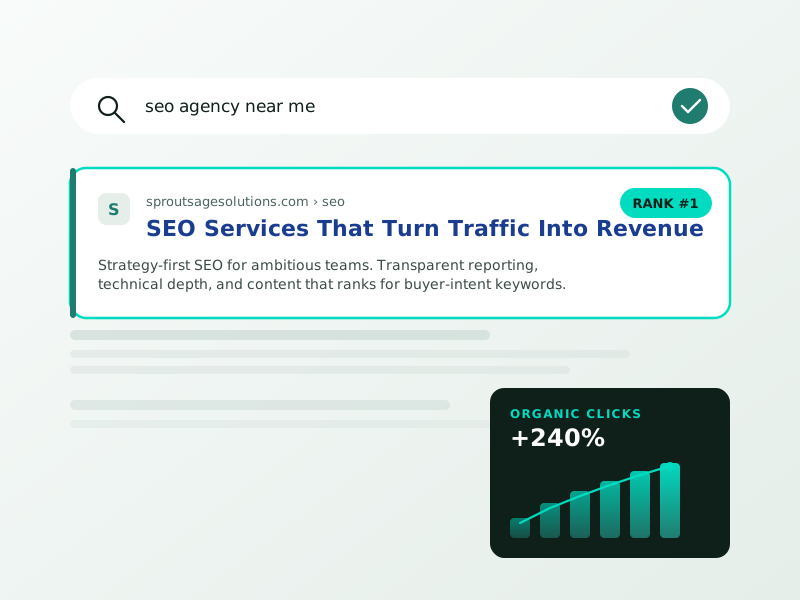
50 medspa marketing questions answered, costs, timelines, Google Ads, SEO, Instagram, how many new patients to expect, and whether medspa marketing actually works.
Table of Contents
You opened a medspa. You have real providers, real equipment, and real services. But patients aren’t walking in the way you expected, and every time you search for marketing answers, you get vague advice from people who’ve never actually marketed a medspa.
This FAQ is different. We’ve worked with 65+ medspas across the US and Canada. These are the real questions owners ask, and the real answers we give them, not the sanitized version.
—
Getting Started
1. How do I start marketing my medspa?
Start with the two things patients use to make decisions before they ever contact you: your Google Business Profile and your website. These are your digital front desk.
Your Google Business Profile (formerly Google My Business) controls what shows up when someone searches “medspa near me.” If it’s incomplete, has wrong hours, or has fewer than 10 reviews, you’re invisible to the most motivated buyers in your market. Complete it fully: add every service, post photos weekly, answer every Q&A, and start asking patients for reviews the same day as their appointment.
Your website needs to do one job: get people to book. That means fast load times (under 3 seconds), a clear booking button above the fold, individual pages for each service, and enough information to make a nervous first-timer feel confident. Most medspa websites fail at this completely, they look good but convert terribly.
Once those two are dialed in, layer in content marketing (blog posts, service pages optimized for local keywords) and paid ads. Not before.
Don’t try to do everything at once. Marketing a medspa is about doing the foundational things well before you spend a dollar on ads. Foundations first, amplification second.
—
2. What’s the first thing I should do to market my medspa?
Claim and fully complete your Google Business Profile. Full stop.
Nothing else matters as much in the first 30 days. Here’s why: 78% of patients searching for a medspa use Google to find one, and Google Business Profile results (the “map pack”) appear above organic results. You don’t need to outrank anyone, you need to show up in those three map spots.
To fully complete your profile: add all service categories, upload at least 20 photos (interior, treatment rooms, exterior, staff), set correct hours, enable messaging, add your services with descriptions and prices, populate the Q&A section yourself with the 10 most common questions patients ask, and respond to every review within 24 hours.
Then start asking every patient for a Google review. A simple text the day after their appointment is enough. “Hi [Name], thank you for visiting us! If you’re happy with your experience, a Google review would mean the world to us.” Add the direct link. That’s it. Practices that hit 25+ reviews in their first 90 days dramatically outperform those that don’t.
Everything else, social media, ads, blogging, comes after you have this locked in.
—
3. How much should a medspa spend on marketing?
The honest range: $500 to $5,000/month depending on your stage, goals, and market.
A brand-new medspa in a smaller market can start at $500/month and focus entirely on Google Business Profile optimization, local SEO, and content. There are no ads yet because you don’t have the reviews and website foundation to convert ad traffic.
An established medspa doing $50K–$150K/month in revenue should be allocating $2,000–$5,000/month including ad spend. When you’re at that revenue level, $3,000/month in marketing that produces $15,000 in new revenue is a straightforward decision.
A medspa in a highly competitive market (major metro, lots of competition) may need $5,000–$10,000/month to compete effectively, a significant portion going toward Google Ads.
The mistake most owners make: spending $0 for 18 months and then dumping $5,000 into ads without the foundation to convert that traffic. You get mediocre results, decide “ads don’t work,” and pull back. Ads only work when your website, reviews, and follow-up system are ready.
—
4. What percentage of medspa revenue should go to marketing?
Industry benchmark: 5–10% of gross revenue.
A medspa doing $30,000/month should be investing $1,500–$3,000/month. At $80,000/month, that’s $4,000–$8,000.
In the first year, you’ll often need to go higher, 10–15%, because you’re building brand awareness from zero. You’re front-loading investment. Think of it less as “expense” and more as “growth infrastructure.”
Once you’re established with a strong reviews profile, good organic rankings, and reliable referral flow, you can hold marketing at the lower end of that range and let organic momentum carry more weight.
The metric that matters more than percentage is cost per acquired patient (CAC). If your average patient LTV is $2,400 (realistic for someone who returns 4–5 times per year for Botox, filler, and one treatment), paying $200–$400 to acquire them is highly profitable. Track what it costs to bring in a new patient per channel, and reallocate toward what’s working.
—
5. Do I need a marketing agency or can I do it myself?
You can absolutely do it yourself, if you have 10–15 hours per week, understand SEO basics, can write clearly, and have someone managing social media. Most practice owners don’t have that time, and that’s the honest answer.
The value of a good medspa marketing agency isn’t just skill, it’s speed, consistency, and industry pattern recognition. An agency that has worked with 30+ medspas knows which keywords convert, what landing page layouts work, which ad types get cheaper CPCs in your category, and what offers drive bookings. You’d spend 6–12 months learning what they already know.
The decision factors:
- Do yourself if: you’re pre-revenue, very early stage, or budget is under $500/month
- Hire agency if: you’re generating revenue and want to grow faster without personally managing marketing
- Hire in-house if: you’re at $200K+/month and need full-time dedicated execution
When evaluating agencies, ask for medspa-specific case studies and references. Generic digital marketing agencies often underperform on medspa accounts. The nuances of medical marketing, HIPAA compliance, and Google’s policies for healthcare advertisers require real category experience.
—
6. How long does medspa marketing take to work?
Depends on the channel:
Google Business Profile optimization: 30–90 days for meaningful improvement in local map rankings. You’ll see results faster if you’re starting from zero in a low-competition market.
SEO (organic search): 3–6 months for initial traction, 6–12 months for significant ranking improvements. Content you publish today may not fully rank for 6 months. This is a long-term channel.
Google Ads: Results start immediately after launch. Within 2–4 weeks, you’ll have enough data to see what’s working. Within 60 days you should have optimized campaigns producing consistent leads.
Social media organic: 3–6 months to build meaningful following and engagement, assuming consistent posting (3–5x/week).
Email marketing to existing patients: Fastest ROI of any channel. A single well-written email to your patient list can generate $5,000–$20,000 in appointments within 48 hours.
Set expectations clearly: medspa marketing is not a 30-day fix. You’re building a system. The practices that grow fastest are the ones who start early, stay consistent, and don’t quit when results feel slow in months 1–2.
—
7. What’s the fastest way to get more medspa patients?
The fastest legitimate results come from three moves:
1. Google Ads targeting service + city keywords. You can go live in 48–72 hours and start getting clicks immediately. Your spend needs to be meaningful ($1,000/month minimum) and your landing page needs to convert.
2. Email and text to your existing patient list. If you have 500+ patients in your system, an email campaign announcing a new service, a seasonal offer, or a “we miss you” to lapsed patients will book appointments within days. Your existing patients are your fastest revenue lever.
3. Review request blitz. If you have fewer than 20 Google reviews, your single highest-ROI activity is texting past patients asking for a review. 20 reviews in 30 days will meaningfully lift your Google map ranking and bring in organic traffic faster than almost anything else.
What doesn’t work fast: SEO, organic social, influencer marketing, or hoping word-of-mouth scales on its own. Those are real channels, but they compound slowly.
—
8. How many new patients should I expect from marketing?
Realistic ranges based on budget and channel:
- $500/month (foundation/SEO only): 5–15 new patients/month once fully optimized, typically 90+ days in
- $1,000/month (SEO + content + basic Google Ads): 15–35 new patients/month
- $2,500/month (full SEO + aggressive Google Ads): 35–75 new patients/month
- $5,000/month (full funnel): 75–150+ new patients/month in most markets
These numbers assume your website converts at 2–4% (industry average), you’re following up with leads within 15 minutes, and your booking friction is low (online booking available).
Variables that affect these numbers significantly: market competition, average ticket price, quality of landing pages, speed of follow-up, and whether you have a strong review profile (50+ reviews makes a measurable difference in both click-through rates and conversion).
One caveat: these are new patient acquisition numbers. Your total appointment volume from marketing will be higher once you factor in return visits from newly acquired patients.
—
> Have a question not covered here? Book a free 15-min call with our team, no pitch, just answers. Book your free call
—
Google & SEO
9. How do I get my medspa on the first page of Google?
“First page” means two things: the map pack (local results) and organic blue links. Both require different strategies.
For the map pack: Google Business Profile is everything. Complete every field, add photos weekly, post updates regularly, and accumulate reviews consistently. The three factors Google weighs most for local rankings are proximity, relevance, and prominence (reviews, citations, engagement). You control relevance and prominence directly.
For organic rankings: You need service pages optimized for “medspa [city]” and “[service] [city]” keywords. Each major service (Botox, filler, laser, body contouring) should have its own page with 500+ words of unique content, proper title tags, meta descriptions, and schema markup. Backlinks from local directories, press mentions, and local websites help significantly.
Both approaches reinforce each other. A strong GBP boosts your local SEO. Strong organic rankings build trust with patients who also check your GBP. Work them together.
Timeline: 3–6 months of consistent work to start appearing for primary keywords in most markets. Highly competitive metros may take 9–12 months. Low-competition markets can move faster.
—
10. Is SEO worth it for a medspa?
Yes, and the ROI compounds over time in a way that paid ads never can.
Here’s the math: ranking organically for “medspa [your city]” or “Botox [your city]” delivers free clicks month after month after month. Once you rank, a patient who finds you through SEO costs you nothing extra. Meanwhile, your Google Ads cost stays the same or increases as competition rises.
The catch is time. SEO takes 3–9 months to produce meaningful results. It’s not instant. But practices that invested in SEO 12 months ago are now generating 30–60% of their new patient volume from organic search at near-zero marginal cost per patient.
The ROI comparison: Google Ads might cost you $200 per new patient (including agency management). SEO, once ranked, might cost $20–$40 per new patient when you amortize the investment over 12 months. The long-term economics are dramatically better.
Don’t choose between SEO and ads, do both, but understand the timeline difference. Ads deliver results now. SEO builds the foundation that reduces your dependence on paid traffic over time.
—
11. How long does medspa SEO take?
Real timeline broken down:
- Month 1: Technical audit, on-page optimization, Google Business Profile work, citation building. No visible ranking changes yet, this is foundation work.
- Month 2–3: Service pages optimized, blog posts published, citations indexed. You may start seeing movement for low-competition long-tail keywords.
- Month 3–6: Primary service + city keywords start moving. You’ll appear on page 2–3 and begin climbing toward page 1.
- Month 6–12: Strong rankings for 5–15 core keywords, meaningful organic traffic, and leads from search.
What speeds it up: a technically clean website, consistent publishing (2+ blog posts/month), active Google Business Profile, and growing review count.
What slows it down: a slow website, duplicate content, no external links pointing to you, and inconsistent posting.
One thing owners underestimate: blog content takes 3–6 months to rank. A post you publish today may not hit page 1 until next quarter. That’s why consistent publishing now pays off later, you’re building a content library that generates traffic for years.
—
12. What keywords should a medspa target?
Start with these three tiers:
Tier 1, High intent, high volume (money keywords):
- “medspa [city]” / “medical spa [city]”
- “Botox [city]” / “lip filler [city]”
- “laser hair removal [city]”
- “body contouring [city]”
Tier 2, Service-specific (easier to rank, high conversion):
- “Botox near me”
- “how much does Botox cost in [city]”
- “best medspa in [city]”
- “[specific treatment] [city]”
Tier 3, Informational (builds authority, long-term SEO):
- “how long does Botox last”
- “Botox vs filler what’s the difference”
- “is laser hair removal worth it”
- “how much does lip filler cost”
Target Tier 1 and 2 on your service and location pages. Target Tier 3 on your blog. Don’t try to rank your homepage for every keyword, create specific, dedicated pages.
Also look at what your top local competitor ranks for using a tool like Ahrefs or Semrush. Find the keywords they’re winning on that you’re not even appearing for. Those are your fastest wins.
—
13. How important is Google Business Profile for a medspa?
It’s the single most important digital asset a medspa has, more important than your website for local patient acquisition.
Here’s why: when someone searches “medspa near me” or “Botox [city],” the map pack with three Google Business listings appears before any organic website results. Most patients click within the map pack. If you’re not there, you’re invisible to the most ready-to-book patients in your market.
Beyond ranking, your GBP is where patients make the decision to call or not. They’re looking at your star rating, your review count, your photos, your hours, and your responses to other reviews. A medspa with 100+ reviews and a 4.8 rating will win that click over a competitor with 12 reviews and a 4.2 rating, even if the second practice is technically better.
Treat your GBP like a second homepage. Post updates at least weekly, respond to every review (especially negative ones, how you respond is what future patients read), keep photos fresh, and answer every question in the Q&A section.
If you do nothing else from this FAQ, make your GBP exceptional.
—
14. How do I get more Google reviews for my medspa?
The best system is automated and frictionless:
Day-of-appointment: At checkout, staff says, “We’d love your feedback on Google, would you like us to text you the link?” 90% of people say yes.
Day 1 post-appointment: Automated text: “Hi [Name], we hope you’re feeling great after your visit! If you’re happy with your experience, we’d be so grateful for a Google review. Here’s the direct link: [link]”
Day 7 follow-up (if no review): One more text. Keep it warm, not pushy.
That system alone will generate 1–3 reviews per week at a typical medspa. In 6 months, you’ll have 50–100 reviews.
Additional tactics: add a QR code in your reception area that links to your review page. Include the Google review link in your post-appointment email. Train every front desk team member to mention reviews at checkout.
What not to do: never offer incentives for reviews (violates Google policy), never ask for reviews in bulk (looks unnatural to Google), and never ask patients to review in the treatment room before they’re fully out.
—
15. Should I use Google Ads or SEO for my medspa?
Both, but prioritize based on your situation.
Use Google Ads first if: you’re a new or established medspa needing patients immediately, you have a marketing budget of $1,500+/month, and your website is ready to convert traffic.
Prioritize SEO first if: you’re a new practice with limited budget and willing to be patient, your market is lower competition, or you want to reduce long-term dependence on paid ads.
The honest truth about “vs”: they’re not competitors. They serve different timeframes. Google Ads brings patients in next week. SEO brings patients in 6 months from now, and keeps doing it for years.
A practice that only does ads is permanently dependent on ad spend. The moment you turn ads off, leads stop. A practice that invests in SEO concurrently is building an asset that generates free traffic even if they cut the ad budget.
Recommended approach: launch Google Ads immediately to get revenue flowing, then simultaneously invest in SEO so you’re reducing your cost per patient over time.
—
16. How much do Google Ads cost for a medspa?
Total monthly investment breaks into two parts: ad spend (money going to Google) and management fee (going to your agency or in-house marketer).
Ad spend: Minimum $1,000/month to get meaningful data and results. Most competitive medspa markets require $1,500–$3,000/month in ad spend to compete effectively. Major metro areas (NYC, LA, Miami, Chicago) can require $3,000–$5,000+/month just in ad spend.
Management fees: Agencies typically charge $500–$1,500/month to manage Google Ads for a medspa.
Total monthly investment: $1,500–$6,500+ depending on market and goals.
On average, a well-managed medspa Google Ads campaign generates a cost per lead (CPL) of $30–$80 and a cost per new patient of $150–$400. With an average patient LTV of $1,500–$3,000+, that’s a strong return when managed well.
Poorly managed campaigns can waste $2,000–$3,000/month with minimal results. This is why agency experience matters, a skilled medspa ads manager knows the right keywords to bid on, what negative keywords to exclude, and how to structure ad groups that produce qualified leads.
—
17. What’s a good cost-per-click for medspa Google Ads?
Benchmark CPCs for medspa-related keywords:
- “medspa near me”: $3–$8
- “Botox [city]”: $4–$12
- “lip filler near me”: $4–$10
- “laser hair removal [city]”: $2–$7
- “body contouring near me”: $3–$9
High-competition markets (major metros) can see CPCs 2–3x higher. NYC or LA Botox keywords can run $15–$25 per click.
A “good” CPC is relative to your conversion rate and patient value. If your landing page converts at 8% and your average new patient spends $400 on a first visit, you can afford a much higher CPC than a practice with a 2% conversion rate.
The metric that actually matters is cost per booked appointment, not CPC. A $10 CPC with a 10% conversion rate means $100 per booked appointment. A $4 CPC with a 2% conversion rate means $200 per booked appointment. Optimize for the former.
Track CPC, click-through rate, landing page conversion rate, and cost per lead, not just CPC in isolation.
—
18. Do Google Ads work for medspas?
Yes, consistently, when set up correctly.
The conditions that make Google Ads work: a service-specific landing page (not your homepage), a mobile-optimized booking form or click-to-call button, leads followed up within 15 minutes, a minimum of $1,000/month in ad spend, and proper conversion tracking installed.
When those conditions are in place, Google Ads for medspas produce a 3:1 to 8:1 return on investment, meaning $3,000 in total ad investment generates $9,000–$24,000 in new patient revenue.
When those conditions aren’t in place, Google Ads can feel like burning money. The ads are “working” in the sense that they’re delivering clicks, but if your landing page doesn’t convert, your follow-up is slow, or you’re bidding on the wrong keywords, leads will not materialize.
Most owners who say “Google Ads didn’t work for me” ran campaigns without dedicated landing pages, didn’t follow up fast enough, or had inadequate ad spend. Fix those variables and the results change dramatically.
—
> Not sure which Google strategy is right for your practice? Book a free 15-min call and we’ll give you a specific recommendation. Book here
—
Social Media
⚡ 2-minute scorecard · instant result
Is your medspa marketing actually converting?
Answer 5 quick questions. Get your score + the top fixes, free.
1. Can patients book online 24/7 without calling?
2. Do you respond to new inquiries in under 5 minutes?
3. Do you run a membership or recurring-revenue program?
4. Are you retargeting site visitors with ads?
5. Are you generating fresh reviews every month?
19. Should my medspa be on Instagram or Facebook?
Instagram for organic content. Facebook for paid ads. Both, ideally, and they’re easy to manage together since they share Meta’s ad platform and you can cross-post.
Instagram is where medspa content thrives organically. Before/afters, treatment videos, provider spotlights, and educational carousels perform exceptionally well on Instagram’s visual feed and Reels format. Your target demographic (women 28–55) actively uses Instagram and searches it for medspa inspiration and social proof.
Facebook is less effective organically but remains powerful for paid ads, especially retargeting campaigns and reaching 35–55 year old women who are higher-value clients. Meta’s audience targeting capabilities are excellent for medspa demographic targeting.
TikTok is a growing opportunity (see Q24) but requires more effort and a different content style.
If you have to choose one for organic content, Instagram. If you have to choose one for paid ads, start with Meta (which covers both Instagram and Facebook ad inventory). They’re connected anyway, just run your ads across both placements.
—
20. How often should a medspa post on social media?
Minimum 3x per week on Instagram to maintain algorithm favorability. 5x per week is better. Daily is ideal if you have content.
More important than raw frequency: consistency. Posting 5 times one week then nothing for 2 weeks is worse than posting 3 times every week without fail.
Content mix recommendation (per week):
- 1–2 educational posts (what is X treatment, why you need Y)
- 1–2 social proof posts (reviews, before/afters, patient testimonials)
- 1 promotional post (offer, membership, new service)
- 2–5 Stories per day (far easier to produce, good for algorithm)
Stories deserve special mention: 5+ Stories per day keeps your account in the front of your followers’ queue. These can be super simple, staff doing a quick treatment walkthrough, a patient selfie in the waiting room (with consent), or a poll about which treatment they want to know more about.
Batch-create content in one session per week, 2–3 hours on a Monday should produce your entire week of feed posts and a queue of Stories to push throughout the week.
—
21. Do I need a social media manager for my medspa?
You need someone consistent, whether that’s an employee, a VA, a freelancer, or an agency. “Winging it when we have time” is not a social strategy.
A dedicated social media manager (whether in-house or outsourced) should be creating content, scheduling posts, responding to DMs and comments within a few hours, monitoring hashtags, and analyzing what’s performing. That’s a 10–15 hour/week role.
Options by budget:
- Under $500/month: Use a scheduling tool (Later, Buffer) and commit to doing it yourself or delegating to your front desk. Require 3 posts/week minimum with a calendar.
- $500–$1,000/month: Hire a freelance social media manager, ideally one with healthcare or beauty industry experience.
- $1,000+/month: Full social management through an agency, content creation, posting, engagement, and reporting included.
The business case: Instagram and Facebook are free traffic. A patient who finds you through a Reel you posted two months ago costs you nothing to acquire. Paying $800/month for social management that brings in even 3–4 patients per month (at $300–$500 average first visit) is a clear positive ROI.
—
22. Do Facebook ads work for medspas?
Yes, Facebook (Meta) ads are highly effective for medspas when used correctly, particularly for offers, new service announcements, and retargeting.
The most effective use cases for medspa Facebook/Instagram ads:
Retargeting campaigns: Show ads to people who visited your website but didn’t book. These are your warmest prospects and convert at 3–5x the rate of cold traffic. Cost per lead is often $15–$40.
Offer campaigns: “New patient special, $99 first Botox area” targeting women 28–55 in a 10-mile radius. When the offer is right and the creative is strong, CPLs of $20–$50 are achievable.
Lookalike audiences: Upload your patient email list, build a lookalike audience of people who match your best patients, and target them. This often outperforms interest-based targeting.
What doesn’t work: generic “we’re a great medspa” brand awareness ads with no specific offer and no urgency. Meta ads need a reason to click now.
Budget recommendation: $800–$1,500/month in ad spend minimum for meaningful results. Below that, the data pool is too small to optimize effectively.
—
23. What kind of content works best for medspa Instagram?
The content types that consistently drive the most reach and engagement:
Before/after photos: The highest-converting content type. Real results build trust and demonstrate your work in seconds. Always get written consent. Always maintain patient dignity.
Treatment walkthrough Reels: 30–60 second video showing a treatment from start to finish. “Day in the life of getting Botox” style content performs extremely well, it demystifies the process and addresses fear-based hesitation.
Provider and staff personality content: People buy from people they trust. Showing your team being human, knowledgeable, and approachable builds the know-like-trust factor that converts followers into patients.
Educational carousels: “5 things you didn’t know about filler” or “Botox vs Dysport, what’s the difference?” Carousels get saved more than any other format (saves signal quality to Instagram’s algorithm).
Patient testimonials on video: Even a 30-second video of a patient saying what they thought going in, what the experience was like, and what they noticed after, is worth 10 text reviews.
What doesn’t work: stock photos, overly polished corporate-looking graphics, promotional posts with no personality, and inconsistent branding.
—
24. Is TikTok worth it for medspas?
Yes, if you have someone who can create native, authentic video content. TikTok is not worth it if you’re going to post the same promotional content you’d post anywhere else.
The opportunity is real: medspa content goes viral on TikTok regularly. Treatment walkthrough videos, “come with me to get Botox” POV content, and honest educational videos about procedures regularly reach 100K–1M views with zero paid promotion. One viral video can bring in more new patients in a week than months of Instagram effort.
The requirement: someone on your team (ideally a provider or personable staff member) who’s willing to appear on camera with genuine personality. TikTok users instantly detect and reject corporate, scripted, or polished content. Authentic wins.
What works on TikTok for medspas: real treatment videos, “what I wish I knew before my first Botox,” day-in-the-life of a provider, honest results after 2 weeks, and educational myth-busting.
If you have the capacity, add TikTok. If you’re already struggling to post consistently on Instagram, fix that first.
—
25. Can before/after photos be used in medspa advertising?
Yes, with restrictions, and they’re worth knowing before you post.
On your website and organic social: Before/after photos are permitted and highly effective. You need written consent from the patient that explicitly covers:
- Use of their images for marketing purposes
- The specific platforms where images will appear
- Whether they can be used in paid advertising
In paid advertising (Meta/Google): Meta (Instagram/Facebook) restricts before/after imagery in ads. You cannot run before/after photos as a standard ad. You can use them in the organic content they appear in, but as a direct ad creative, they’re restricted.
Google Ads: Google allows before/after images in some ad formats for healthcare, but not in others. Work with a healthcare-experienced ads manager to navigate this.
HIPAA: Even with signed consent, you must ensure that nothing in the image (visible tattoos, identifiable background details, visible identifying information) can reveal a patient’s medical status without their explicit knowledge.
Best practice: have a standalone photo release form that patients sign. Keep it on file digitally. Make the ask easy and patients are generally happy to say yes.
—
26. What are the HIPAA rules for medspa social media?
HIPAA applies to any protected health information (PHI), which includes patient identities connected to their treatment status. Here’s what that means for social media practically:
Never post: a patient’s name, photo, or identifying information alongside their treatment unless you have explicit signed authorization that specifically covers that use. This includes tagging patients, posting before/afters with names, or sharing patient stories without written consent.
Authorization requirements: Your consent form must specify what information can be shared, where it can be shared (website, Instagram, paid ads), and the patient must sign it before any posting occurs. A verbal “sure, go ahead” is not sufficient.
Reviews and testimonials: When patients voluntarily write a public Google review, you’re generally safe to reference it. However, responding to a review and confirming treatment details could be a HIPAA violation, even to say “we’re glad your filler appointment went well.” Simply thank them for their feedback.
Staff posts: Educate your team that posting anything about a patient, even something positive and seemingly harmless, without documented consent is a violation.
Consult a healthcare attorney to review your consent forms. A proper HIPAA-compliant release form costs $300–$500 to have drafted and protects you permanently.
—
> Have a question not covered here? Book a free 15-min call. Book here
—
Leads & Conversions
27. What’s a good lead-to-booking rate for a medspa?
Industry benchmark: 20–40% of inbound leads should convert to booked appointments.
If you’re below 20%, something in your process is leaking, too slow to follow up, wrong staff handling calls, website friction making it hard to book, or misaligned offers bringing in unqualified leads.
Best-in-class practices convert 40–60% of qualified leads. How? They follow up within 5–15 minutes of lead submission (every hour of delay drops conversion rate by 20%+), they have a staff member specifically trained to handle lead calls (not just whoever answers), they offer multiple booking options (phone, text, online), and they have a clear offer that makes saying yes easy.
Track this metric. Pull your total inbound leads per month from all channels and compare it to booked appointments. If you’re generating 100 leads/month and booking 15 appointments, you have a conversion problem worth solving, before spending more on ads.
—
28. How do I convert more medspa leads into appointments?
The five highest-impact changes for conversion:
1. Speed up your follow-up. 78% of leads go with the first practice that responds. Respond within 15 minutes, 7 days a week.
2. Offer text as a response option. Many leads prefer text over phone. If your form only offers a callback, you’ll lose the segment that hates phone calls.
3. Reduce booking friction. If booking requires calling during business hours and waiting on hold, you’ll lose leads. Add online booking, add a “request appointment” form, make it easy to say yes.
4. Train your front desk on conversion. The person answering inquiry calls needs to know how to handle objections, answer pricing questions confidently, and guide the patient to a specific appointment rather than just giving information.
5. Send a follow-up sequence. Leads who don’t book on first contact often book 5–10 days later if you follow up. A simple 3-part text/email sequence (Day 1 contact, Day 3 follow-up, Day 7 final check-in) will recapture 15–25% of leads who didn’t initially convert.
—
29. How fast should I follow up with medspa leads?
Within 15 minutes during business hours. If your form submission comes in at 6pm, respond first thing the next morning, no later.
The data is clear: leads contacted within 5 minutes are 21x more likely to convert than leads contacted after 30 minutes. Leads contacted within an hour are 7x more likely to convert than leads contacted after 24 hours.
Medspas are a considered purchase with fear-based friction. A new patient filling out an inquiry form is often anxious, researching multiple options, and easy to lose to a competitor who calls faster.
System to enable this: use a CRM or booking platform (Mindbody, Jane, Aesthetic Record, HoneyBook) that sends immediate auto-text acknowledgment (“Thanks for reaching out! A team member will text you within 15 minutes.”). Then have a human follow up. The auto-response buys you time and signals responsiveness.
For after-hours leads: set up automatic responses that acknowledge the inquiry and set expectations (“We’ll be in touch by 9am tomorrow”). Then fulfill that promise.
—
30. Why are my medspa leads not converting?
The most common conversion killers, in order:
Slow follow-up: If you’re taking more than an hour to respond, leads have already called someone else. This is the #1 conversion killer.
Price shock without context: Leads ask “how much is Botox?” and get a number with no context about value, experience, or outcome. Train staff to address pricing with confidence and context.
No online booking: Many patients, especially millennials, will not call to book. They want to book themselves online at 10pm. If you don’t offer it, they leave.
Wrong staff handling calls: A front desk person who’s apologetic about pricing, uncertain about treatments, or slow to offer a specific booking time will leak leads.
Unqualified leads from bad targeting: If your ads are reaching everyone in a 25-mile radius with no demographic filters, you’re getting a lot of window-shoppers. Tighten your targeting.
No follow-up sequence: 60–70% of leads who don’t book immediately can be recaptured with 2–3 thoughtful follow-ups. Most practices follow up once and then never again.
—
31. Should I use a medspa CRM?
Yes, once you’re generating more than 20 leads/month. Before that, you can manage leads manually with a spreadsheet. At 20+ leads/month, leads will fall through the cracks without a system.
What a CRM does for you: tracks every lead from first contact to first appointment, automates follow-up sequences, reminds staff when a lead hasn’t been contacted, and shows you your conversion rate by source. That last piece is critical, you need to know whether your leads are coming from Google Ads, Instagram, referrals, or organic search so you know where to invest.
The business case: practices that use a CRM and follow-up automation typically increase their lead-to-booking conversion rate by 20–35%. If you have 50 leads/month and currently convert 25%, getting to 35% with a CRM means 5 additional patients per month, at $300–$500 average first visit, that’s $1,500–$2,500/month in additional revenue from the same lead volume.
—
32. What’s the best CRM for a medspa?
Depends on your size and what you already use for bookings:
All-in-one medspa platforms with CRM built in:
- Aesthetic Record, strong for injectors, built-in EMR + CRM + marketing automation
- Mindbody, booking + marketing automation, widely used
- Jane App, popular in Canada and US, clean interface, good automation
Standalone CRM (for practices needing more sophisticated marketing automation):
- HubSpot (free tier works for small practices)
- GoHighLevel, popular with agencies and medspas, robust automation
- Keap, good for follow-up sequences
What features actually matter for medspas:
- Lead capture from website forms
- Automated text/email follow-up sequences
- Appointment reminders
- Lead source tracking
- Re-engagement workflows for lapsed patients
- Integration with your booking system
Don’t overthink the choice. A basic CRM used consistently beats a sophisticated one nobody logs into. Start simple, add complexity as you need it.
—
> Have a question not covered here? Book a free 15-min call. Book here
—
Pricing & Budgets
33. How much does medspa marketing cost per month?
Real-world ranges based on what’s actually included:
$300–$600/month: Basic digital presence management, GBP optimization, citations, monthly reporting. No ads, minimal content. Appropriate for brand-new practices in low-competition markets.
$600–$1,500/month: Foundation marketing, local SEO, 1–2 blog posts/month, GBP management, possibly light social media. No substantial ad spend.
$1,500–$3,000/month: Full SEO + content + modest Google Ads. This tier starts producing meaningful new patient volume consistently.
$3,000–$6,000/month: Full-service medspa marketing, SEO, content, Google Ads, Meta Ads, social media management, email marketing, reporting. This is where aggressive growth happens.
$6,000–$15,000+/month: High-growth medspa brands in competitive markets or multi-location practices with significant ad budgets.
At Sprout Sage Solutions, our entry point is $500/month with no contract. We work with 65+ medspas and scale investment with results.
—
34. What does a $500/month medspa marketing plan include?
The $500/month Starter plan at Sprout Sage Solutions is built for brand-new medspas or practices in lower-competition markets who want a strong foundation before committing larger budgets.
What’s included:
- Google Business Profile optimization: Complete profile setup or audit, weekly posts, Q&A population with 10+ answers, category optimization, and citation building across 20+ directories (Yelp, Healthgrades, RealSelf, Bing, Apple Maps, etc.)
- On-page SEO for 3 core service pages: Keyword research, optimized title tags, meta descriptions, headers, and 500+ word content for your 3 highest-priority services
- 1 blog post/month: 800–1,200 word SEO-targeted post on a keyword relevant to your services and location
- Monthly report: Real metrics, GBP views, search impressions, website traffic, keyword rankings, not vanity numbers
What’s not included: Paid ads, social media management, email marketing.
Best for: New medspas launching in markets without dominant competition, or established practices who’ve never done structured SEO and want to test before committing more. Also ideal for practices that have a marketing manager in-house but need the strategic oversight and SEO execution.
No ads, no contract. You can cancel or scale up at any time.
Questions? Book a free call or call/WhatsApp +91 9729712388.
—
35. What does a $1,000/month medspa marketing plan include?
At the $1,000/month level, you’re getting full local SEO infrastructure plus enough content to start producing meaningful organic traction.
Typical inclusions at this tier:
- Complete Google Business Profile management (posts, Q&A, review response strategy, photo updates)
- On-page SEO for all major service pages (5–8 pages optimized)
- 2 blog posts/month targeting service + location keywords
- Citation management across 40+ directories
- Basic link building (local directories, partnerships, guest posts)
- Monthly reporting with rankings, traffic, GBP performance, and leads
- Basic conversion audit of landing pages
You may also see limited Google Ads management at this tier, though ad spend would be separate and you’d need at least $500–$700/month in additional ad budget to make it worthwhile.
ROI expectation: at 6 months, this tier typically produces 10–25 additional organic visitors per month (depending on market) and measurable improvement in GBP visibility. Enough to demonstrate clear ROI before scaling.
—
36. Is $500/month enough for medspa marketing?
For building a foundation: yes. For producing a meaningful volume of new patients immediately: probably not.
Here’s the honest reality: $500/month covers strategic foundation work, GBP optimization, local SEO, citations, and basic content. This creates the infrastructure that compounds over time. At month 6–9 in a low-competition market, practices on $500/month plans are often generating 8–15 new patients/month from organic sources alone.
What $500/month won’t do: produce immediate new patient volume through paid advertising or manage your full digital presence across social, email, and ads.
The right question isn’t “is $500 enough?”, it’s “what do I need right now?” If you’re a new practice needing patients this month, $500 in SEO won’t solve your immediate need. Add $1,000–$1,500 in Google Ads on top and you have a complete short-term strategy.
If you’re an established practice with existing patient flow who wants to build long-term organic presence without a massive investment, $500/month is a very sensible starting point.
We offer a $500/month Starter with no contract so you can test before scaling.
—
37. What marketing budget do I need to open a new medspa?
For a medspa opening from scratch, budget these marketing investments in your first 12 months:
Pre-launch (1–2 months before opening):
- Website design and development: $3,000–$8,000
- Photography and video (interior, staff, treatments): $1,500–$3,000
- Google Business Profile setup: $300–$500 one-time
First 3 months post-launch:
- Marketing agency/consultant: $1,000–$2,000/month
- Google Ads to drive immediate traffic: $1,500–$3,000/month ad spend
- Social media content creation: $500–$1,000/month
Months 4–12:
- Marketing agency retainer: $1,500–$3,000/month
- Ongoing ad spend: $1,500–$2,500/month
- Content, email, social: included in retainer
Total first-year marketing investment: $35,000–$65,000 for a full-scale launch. Lean version with a good agency and controlled ad spend: $25,000–$40,000.
This sounds like a lot. But a medspa generating $80,000/month in revenue, a realistic target by month 12 for a well-marketed practice, makes that investment very rational.
—
38. When does medspa marketing ROI turn positive?
Channel by channel:
Google Ads: Month 1–2. Ads produce leads almost immediately. By month 2–3, a well-optimized campaign should be producing a positive ROI (more in new patient revenue than total ad investment).
Email marketing to existing patients: Immediately. Your first email campaign can produce positive ROI on day one.
Local SEO / GBP optimization: Month 3–6, depending on market competition. You’ll start seeing ranking improvements at 30–60 days, but meaningful traffic and leads typically materialize at 3–6 months.
Organic blog content / full SEO: Month 6–12. Content takes time to rank. The ROI is excellent once established, but the payback period is longer.
Social media organic: 6–12 months. Rarely a primary patient acquisition channel in the first year, more of a trust and retention tool.
The most common mistake: measuring marketing ROI at 30 days and quitting because the numbers don’t look good. Give Google Ads 60 days to optimize. Give SEO 6 months. The practices that stay consistent are the ones that win long-term.
—
> Have a question not covered here? Book a free 15-min call. Book here
—
Agency Questions
39. How do I find a good medspa marketing agency?
Start by filtering for category specialization. A general digital marketing agency that “also does healthcare” is not the same as a team that has managed 20+ medspa accounts. The category knowledge gap is real, keyword selection, HIPAA compliance in advertising, understanding patient psychology, knowing which Google policies apply to healthcare advertisers, and understanding what offers work in medspa markets are all things that require hands-on medspa experience.
How to evaluate:
- Ask for medspa-specific case studies, not just any healthcare or “service business.” Ask what they did, what the starting point was, what results they achieved, and how long it took.
- Ask for references you can actually call, a 5-minute conversation with one of their medspa clients tells you more than any pitch deck.
- Ask who will be managing your account, many agencies sell you on senior leadership but hand you off to a junior contractor.
- Ask how they measure success, the right answer involves real metrics: new patient volume, cost per acquisition, ranking improvements. The wrong answer is impressions and follower counts.
Good agencies are transparent about what they can and cannot do, don’t promise page-one Google rankings in 30 days, and will tell you when your budget isn’t sufficient to achieve your goals.
—
40. What should a medspa marketing contract include?
Before signing any agency contract, confirm it covers:
Scope of work: Exactly what deliverables are included each month. “Marketing services” is not a scope, “2 blog posts, 8 GBP posts, on-page SEO for 5 pages, monthly reporting” is a scope.
Term and cancellation: How long is the initial commitment? What notice is required to cancel? Month-to-month is ideal. If they require 6–12 months, understand why.
Ownership: Do you own all content, website changes, and ad accounts created? You must. If they retain ownership of anything, walk away.
Reporting: What metrics are reported, how often, in what format?
Ad spend management: Is ad spend billed separately from management fees? Who has access to and controls the ad accounts?
Communication and response time: What’s the turnaround on questions? Who is your primary contact?
Performance expectations: Reputable agencies will set realistic ranges, not guarantees. Be skeptical of anyone guaranteeing specific rankings or patient volumes.
Red flags: ownership retained by agency, no clear reporting, no cancellation path, and guarantees that sound too good.
—
41. Should I hire a medspa marketing agency or a freelancer?
Both have real merit. The decision depends on your needs, budget, and risk tolerance.
Agency advantages:
- Team of specialists (SEO person, ads person, content writer, designer)
- Redundancy, if one person is sick, work continues
- Breadth of services under one contract
- Accountability structure and reporting
Freelancer advantages:
- Often cheaper for single-channel work
- More personal attention from the person actually doing the work (no hand-off to junior staff)
- Flexibility to hire one specialist per channel
Best approach by stage:
- New practice, limited budget: Start with a freelancer for the 1–2 highest-priority channels
- Growing practice ($30K–$80K/month revenue): Agency for full-service management, or 2–3 specialized freelancers coordinated by an in-house marketing coordinator
- Scaling practice ($80K+/month): Agency with proven medspa results or a small in-house team
One caution about freelancers: vetting is harder. There’s no agency behind them to back up quality. Ask for extensive portfolio work, talk to references, and start with a paid test project.
—
42. What questions should I ask a medspa marketing agency?
The 10 questions that separate real expertise from sales talk:
- How many medspa clients are you currently managing?
- Can you share a specific case study, starting metrics, what you did, end metrics?
- Who will be managing my account day-to-day?
- How do you handle HIPAA compliance in ad creative and social media?
- What’s your process for the first 30 days?
- How do you measure success and what does reporting look like?
- What results are realistic for my budget and market in months 3, 6, and 12?
- Do I own all accounts, content, and assets you create?
- What’s the cancellation process and notice period?
- What’s the one thing that most determines whether a medspa marketing campaign succeeds or fails?
That last question reveals a lot. An agency with real experience will tell you it’s the speed of lead follow-up, the quality of the website, or the review profile. An agency without experience will tell you it’s their creative or their proprietary system.
—
43. What do medspa marketing agencies typically charge?
Market rates as of 2026:
Local SEO and GBP management only: $300–$800/month
Full SEO (content, on-page, link building): $800–$2,000/month
Google Ads management (management fee only, not ad spend): $500–$1,500/month
Social media management (content + posting): $800–$2,000/month
Full-service medspa marketing (SEO + ads + content + social + email): $2,500–$6,000/month
High-touch boutique agencies with proven medspa track record: $4,000–$10,000+/month
Beware of extremely cheap services ($99–$200/month “all-inclusive” plans). At that price point, either you’re getting bare-minimum work with no real strategy, offshore execution with poor English content, or a templated approach with no customization. You usually get what you pay for.
Also beware of inflated pricing without results. Always ask for references and case studies, price alone doesn’t indicate quality.
—
44. Is it worth paying for a medspa marketing agency?
For most practices generating $20,000+/month in revenue: yes.
The math: a practice at $40,000/month revenue investing $2,000/month in a good marketing agency and $1,500/month in ad spend ($3,500 total) that produces 20 additional new patients per month at $400 average first visit generates $8,000 in new first-visit revenue. That’s a 2.3x return on month one alone, not counting the patient lifetime value of those 20 people returning multiple times.
When it’s NOT worth it:
- Pre-revenue practice with no budget for proper execution
- Agency can’t provide references or case studies
- You’re under $10,000/month revenue and need to survive first
- The agency is generic and has never worked in medspa/aesthetics
The ROI question to ask before hiring: “If this agency delivers 15 new patients/month, is that worth the monthly fee?” In most cases, the answer is a clear yes, because the LTV of a medspa patient who returns 3–5 times per year far exceeds the cost of acquisition.
At Sprout Sage Solutions, we work with 65+ medspas and our entry point is $500/month with no contract. Book a free 30-min audit.
—
> Have a question not covered here? Book a free 15-min call. Book here
—
Specific Treatments
45. How do I market Botox at my medspa?
Botox is your highest-volume, highest-lifetime-value service. Marketing it well creates a loyal patient base that returns every 3–4 months.
Search: “Botox [city]” is one of the most commercially competitive local keywords. Create a dedicated Botox page optimized for that keyword plus long-tails like “how much does Botox cost in [city],” “best Botox injector [city],” and “Botox near me.” Include your pricing ranges (even if you do custom quotes, give a range, “starting at $12–$14/unit”).
Google Ads: Botox converts well from search ads because intent is so clear. A patient searching “Botox [city]” is extremely close to booking. Bid on those terms with a dedicated landing page and a clear offer.
Social media: Botox content on Instagram and TikTok performs exceptionally well. Before/afters showing subtle but real improvements, “day 14 after Botox” update videos, and myth-busting content (“Botox doesn’t make you look frozen, here’s the truth”) drive engagement and lower fear barriers.
Offer strategy: A “first-time patient” Botox promotion (e.g., $10/unit for the first visit vs. standard $12–$14/unit) brings in new patients who then become long-term members of your Botox schedule.
—
46. How do I market laser hair removal?
Laser hair removal is a multi-treatment commitment and a strong gateway to other services. It’s also price-competitive because patients shop around extensively.
Lead magnet approach: Offer a free consultation or assessment. Patients are often unsure whether they’re a good candidate (skin tone, hair color, treatment area). A free consultation gets them in the door with low friction.
SEO focus: “Laser hair removal [city],” “laser hair removal for [skin tone] skin,” “how many sessions for laser hair removal,” and “laser hair removal cost [city]” are all highly searched. Create content answering these questions.
Package marketing: Sell 6-treatment packages upfront at a discount (e.g., 6 sessions for the price of 5). This increases average transaction value and commits the patient to coming back. Email and social campaigns showing package offers perform well.
Before/after content: Progress photos across a 6-treatment series are compelling. With patient consent, document the journey, session 1 through session 6. This type of content builds incredible trust.
Seasonal campaigns: “Start now, be hair-free by summer” in January–February. “Prep for shorts season” in March. Seasonality drives urgency.
—
47. How do I market body contouring services?
Body contouring (CoolSculpting, Emsculpt, Morpheus8, RF treatments) requires more education-first marketing because it’s less understood than injectables.
Education is your primary marketing tool. Most potential patients don’t fully understand how it works, what results are realistic, or who’s a good candidate. Content that answers “what can body contouring realistically do?” and “am I a good candidate?” will attract highly qualified leads.
Before/after and results content: Nothing converts like documented results. 8-week and 12-week post-treatment photos with honest descriptions of the process (“this is what the treatment feels like, this is what I noticed at week 4, this is week 8”) build trust more than any ad.
Consultation offers: A free body contouring consultation gets qualified leads into your practice. The consultation itself is the close, when a patient sees their specific area assessed and hears a realistic treatment plan, conversion rates are high.
Video content: Treatment walkthroughs on Instagram and TikTok, showing the device, the session, patient reactions, demystify the treatment and reduce the friction of “I don’t know what this involves.”
Targeted ads: Facebook and Instagram ads targeting women 35–55 within your market with interest in health, fitness, and body wellness convert well for this service category.
—
48. How do I market memberships at my medspa?
Medspa memberships are the most powerful revenue tool available, they create predictable monthly recurring revenue and dramatically increase patient retention. Marketing them requires a shift from transactional to relationship-based messaging.
Position the value, not the discount. “Join our membership and save 20% on every visit” is weak. “Our Glow Membership gives you monthly Botox, priority booking, and exclusive member pricing, starting at $199/month” positions it as a lifestyle choice.
Launch offer: “Founding member” or “charter member” pricing creates urgency for first adopters. Offer a special rate for the first 50 or 100 members.
In-practice selling: Train your front desk to mention the membership at checkout, “Did you know members pay $X less per treatment? Let me show you how it works.” The best time to sell a membership is right after a great patient experience.
Email campaign: Your existing patient email list is your best audience for membership conversion. A 3-email sequence explaining the value, answering objections (What if I miss a month? What if I want to cancel?), and offering founding member pricing typically converts 5–15% of recipients.
Ongoing social content: Member spotlights, “why I joined the Glow Club” style testimonials, and monthly membership stats (“456 members can’t be wrong”) reinforce the community aspect.
—
49. How do I market to male medspa patients?
The male medspa market is growing rapidly, men now represent 15–20% of medspa patients and are one of the fastest-growing demographics. But they respond very differently to marketing than women.
Language matters: Words like “refresh,” “grooming,” “performance,” and “maintenance” resonate with men. Words like “pampering” and “luxury” don’t. Botox for men is often positioned around looking refreshed and maintaining a competitive edge, not aesthetic enhancement.
Education reduces barrier: Many male patients have never been to a medspa and don’t know what to expect. Content framed as “what to expect on your first visit” or “treatments men actually get at a medspa” reduces fear-based hesitation significantly.
Masculine framing of treatments: “Brotox,” “male sculpting,” “jaw slimming,” “sweat reduction”, position services through a lens that connects to male concerns: looking sharp, not looking tired, confidence, competitive edge.
Google Ads targeting: Target men specifically with tailored ad copy. “Look as good as you perform” outperforms generic medspa copy for a male audience.
Referral from female patients: The majority of male patients are first referred by a partner, sister, or female colleague. Encourage your existing female patients to bring partners or refer men in their network, a referral offer targeting this pathway can be effective.
—
Retention & Reviews
50. How do I get patients to come back to my medspa?
Retention is where the real money is. Acquiring a new patient costs 5–7x more than retaining an existing one. The practices with the highest profitability are rarely the ones with the most new patients, they’re the ones who keep the patients they have.
Automated follow-up sequences: Every patient should receive a structured post-treatment sequence. Day 1: treatment recap + care instructions. Day 3: review request. Day 7: how are you feeling, any questions? Day 30: time to book your maintenance appointment. Day 60–90: you’re likely due for your next session.
Membership programs: Patients on monthly memberships return at 3–4x the rate of one-time patients. Even a basic membership ($99/month for priority booking and 15% off all services) dramatically increases retention.
Birthday campaigns: An automated birthday text with a small offer (“Happy birthday! We’d love to treat you, $50 off any treatment this month”) generates consistently high booking rates and creates emotional connection.
Lapse reactivation: At 4 months since last visit, flag patients as “at-risk lapsed.” Send a reactivation sequence: “We miss you at [Practice Name]. Here’s what’s new, and here’s a reason to come back.” A single well-timed text recovers 15–25% of patients who might otherwise churn silently.
Review requests: Patients who write reviews feel invested in your practice’s success. They come back. Ask for reviews at day 3 post-appointment, not day 1 (they’re still evaluating), not day 30 (too late).
Relationship investment: The most retained patients are the ones who feel like your staff actually knows them. Train providers and front desk to review patient notes before every appointment. Personalizing the experience, remembering that she mentioned a big birthday, asking how the event went, is irreplaceable.
—
> Ready to put these answers into action for your practice? > > Sprout Sage Solutions works with 65+ medspas. Our entry point is $500/month with no contract, built so you can see results before committing more. > > Book a free 30-minute strategy call: calendly.com/workwithmandeep/30min > > Call or WhatsApp: +91 9729712388
—
*Updated May 2026. Sprout Sage Solutions specializes in medspa marketing across the US and Canada. All recommendations reflect current platform policies, industry benchmarks, and real client data from 65+ medspa accounts.*
Ready to turn this into real bookings?
Free 30-min audit. We review your current setup and give you 3 specific wins — whether we work together or not. Starts at 0/month. No contract. One medspa per market. Book a free 30-minute strategy call, I will review your setup and give you 3 specific fixes.
Book My Free Audit →No credit card. No pitch. No 12-month lock-in.



