

IV Therapy & Vitamin Drip Marketing: How to Build a Profitable IV Program at Your Medspa (2026)
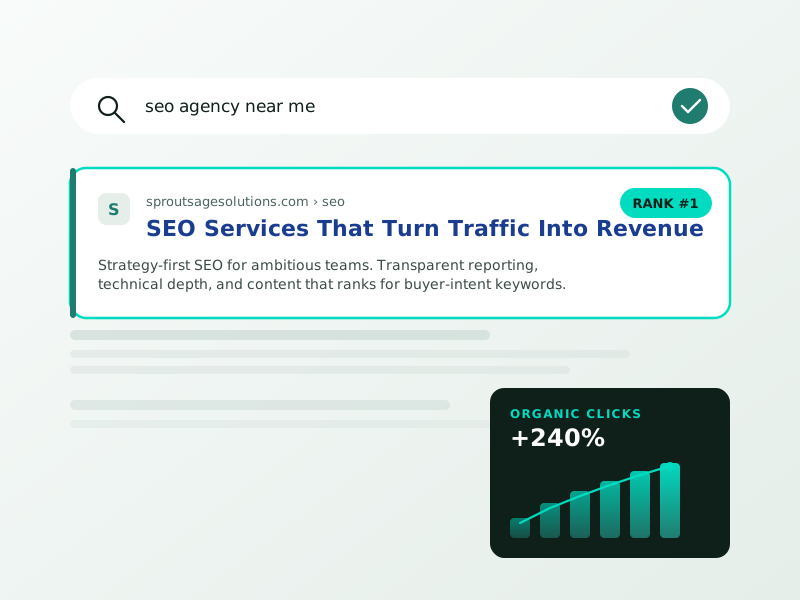
IV therapy marketing for medspas — how to position your drip bar, target the right audiences, use event marketing, and build recurring IV membership revenue.
Table of Contents
- 1. The IV Therapy Market Opportunity
- 2. Who Your IV Patients Are: Four Key Audiences
- 3. Social Media Strategy for IV Therapy
- 4. Event and Mobile IV Marketing
- 5. The IV Membership Model
- 6. GLP-1 + IV Therapy Synergy: The Upsell
- 7. Google Ads and SEO for IV Therapy
- 8. Regulatory Considerations
- Work With Sprout Sage Solutions
Google searches for “IV therapy near me” have grown 300% in three years. That is not a fad — it is a structural shift in how patients think about wellness, recovery, and optimization. IV therapy has moved from a niche offering at boutique wellness clinics to a mainstream service that sophisticated patients actively seek out and willingly pay premium prices to access.
For a medspa, IV therapy represents one of the most attractive revenue additions in the current market. The setup cost is low relative to most equipment-intensive services. The perceived value dramatically exceeds the actual product cost. The visual experience — a patient relaxing in a comfortable chair with a beautifully labeled IV bag — is inherently social media content. And the clientele who seek IV therapy tend to be high-income, wellness-oriented repeat buyers who are natural candidates for your broader treatment menu.
This guide is about building the marketing system that fills your IV chairs — not just occasionally, but consistently. It covers the four audiences who drive IV revenue, social media strategy, event marketing, membership models, the GLP-1 connection, SEO and paid ads, and the regulatory considerations you need to keep in mind.
—
1. The IV Therapy Market Opportunity
The IV therapy market was valued at $2.1 billion in 2024 and is growing at approximately 8% annually. More significant than the global number is the local concentration of demand: IV therapy is an intensely local service. Patients will not drive 45 minutes for an IV drip. They search “IV therapy near me” and they book within their immediate geography.
This means the IV therapy market in your city is a local competition — and in many mid-size markets, it is still relatively uncrowded. Mobile IV therapy companies have captured some of the market, but they lack the clinical environment, the treatment diversity, and the ability to combine IV therapy with other services that a medspa can offer.
The medspa advantage in IV therapy: You already have the clinical infrastructure, the licensed staff, and the existing patient base. Adding IV therapy to your service menu does not require building a new business — it requires extending your existing marketing reach to a new audience and adding IV therapy as a natural upsell to patients already coming to you for aesthetics and wellness services.
The upsell and cross-sell economics: A patient who comes in for Botox and adds a $175 hydration IV to their appointment has just increased their visit revenue by 50–70%. A body contouring patient who adds a NAD+ drip to support their recovery has just added $250–$400 to their transaction. IV therapy is not just a standalone revenue line — it is a value multiplier across your entire treatment menu.
—
2. Who Your IV Patients Are: Four Key Audiences
Not all IV therapy patients have the same motivation, and effective IV marketing means speaking specifically to each audience’s actual driver. Generic “hydration and wellness” messaging misses the specificity that converts.
Audience 1: Fitness and performance clients. Athletes, gym members, CrossFit regulars, weekend warriors, and high-intensity fitness enthusiasts. Their motivation is performance and recovery — reduced muscle soreness, faster recovery between training sessions, optimal electrolyte balance, vitamin B12 for energy, amino acids for muscle repair. They are often male, often in the 28–45 range, and they respond to performance language (“recover faster,” “train harder,” “optimize your output”) rather than wellness or beauty language.
Channels to reach them: gym partnerships, fitness studio collaborations, athletic community social media, and sports/performance-focused Google search terms. A dedicated landing page for “IV therapy for athletes [city]” or “post-workout IV recovery [city]” captures this audience from search while the generic “IV therapy near me” page misses the segmentation.
Audience 2: Hangover recovery and hospitality workers. One of the original IV therapy audiences, and still highly relevant. The hospitality industry — bartenders, servers, hotel staff, event workers — has high rates of dehydration and next-day recovery needs. Bachelorette parties and bachelor groups arriving Saturday morning are a reliable recurring segment. Las Vegas built an entire sub-industry around this audience.
The opportunity in most markets is less saturated than you might expect because most medspas feel uncomfortable marketing to this audience. But dehydration is dehydration, and there is nothing clinically questionable about providing premium hydration services to adults who need them. “Recover faster, feel better sooner — our hydration drip restores electrolytes and B vitamins in 45 minutes” is a legitimate clinical service with a real demand.
Channels: Instagram and TikTok (bachelorette party content), hotel concierge partnerships, event space partnerships, Yelp reviews specifically tagged for hangover recovery.
Audience 3: Busy professionals and executive wellness clients. This is your highest-LTV IV therapy segment. High-income professionals — executives, attorneys, physicians, entrepreneurs — who are under chronic stress and seeking performance optimization. They are drawn to NAD+ for cognitive performance and longevity, immune support formulas during high-stress periods, energy IVs before major events or presentations, and the concept of “biohacking” their way to better performance.
This audience responds to premium positioning, clinical credibility, and time efficiency. “Our NAD+ protocol is a 2-hour infusion. Many clients work during their session — we have Wi-Fi and a quiet, professional environment.” They are price-insensitive relative to the general population and respond strongly to personalized protocol language.
Channels: LinkedIn, premium business publications (ads or editorial coverage), corporate wellness partnerships, executive health program affiliations.
Audience 4: Chronic wellness seekers and integrative health patients. Patients managing fatigue, immune challenges, hormonal transitions, post-illness recovery, or general “not feeling optimal” status who have not found satisfactory answers in conventional medicine. They are already deeply research-oriented, already investing in supplements and wellness products, and actively seeking clinical support that goes beyond what a GP provides.
NAD+ for energy and cellular health, high-dose vitamin C for immune support, glutathione for antioxidant support, and Myers cocktail formulas all resonate with this audience. They read wellness publications, follow integrative health influencers, and place high value on clinical credibility and individualized protocol design.
Channels: wellness podcasts and newsletters (sponsorship or editorial), integrative health community partnerships, local naturopath and functional medicine referral relationships.
—
3. Social Media Strategy for IV Therapy
⚡ 2-minute scorecard · instant result
Is your medspa marketing actually converting?
Answer 5 quick questions. Get your score + the top fixes — free.
1. Can patients book online 24/7 without calling?
2. Do you respond to new inquiries in under 5 minutes?
3. Do you run a membership or recurring-revenue program?
4. Are you retargeting site visitors with ads?
5. Are you generating fresh reviews every month?
IV therapy is one of the most naturally visual medspa services. The aesthetic of a clean, professional drip bar — beautiful IV bags hanging on polished stands, a patient relaxing with a monogrammed blanket, custom-labeled vitamin formulas — is inherently Instagrammable in a way that most medical services are not.
Instagram and TikTok content pillars:
“What is in the drip” content performs consistently. A Reel or TikTok that walks through the ingredients in a specific formula — “here is exactly what is in our energy boost IV and what each ingredient does” — is educational, trustworthy, and highly shareable. It also establishes your clinical credibility in a format the algorithm rewards.
Patient experience walkthroughs. A 60-second video showing the check-in experience, the consultation, the room setup, the actual drip process, and the patient’s comment afterward is far more persuasive than any written description. “What it is actually like to get IV therapy” is a top-searched query on YouTube and TikTok.
Staff and provider content. The RN or NP administering your IV therapy has a face and a story. Provider-forward content builds trust and humanizes the service. “A day in our drip bar” or “your questions about IV therapy answered by our nurse” content builds following and drives direct messages that convert to bookings.
Aesthetic drip bar photography. Professional photography of your IV suite — the lighting, the branding, the menu board, the IV bags — generates saves and shares. People share beautiful spaces to their stories. Make your drip bar worth photographing.
User-generated content strategy: Incentivize patients to tag your clinic in their IV session posts. A small discount on their next service in exchange for a tag is a standard and effective tactic. UGC is more trusted than branded content and extends your reach to every tagger’s followers.
—
4. Event and Mobile IV Marketing
Event marketing is one of the highest-ROI channels for IV therapy because it combines brand exposure, immediate revenue generation, and list building in a single activity.
Pop-up IV bars at gyms and fitness studios: Contact the manager of premium gyms, CrossFit boxes, yoga studios, and cycling studios in your area about hosting a pop-up IV drip station on a Saturday morning. You bring the equipment and staff for a 4-hour event. Gym members who try IV therapy on-site at a promotional price become regular patients. The gym gets a value-added event for their members. You acquire qualified patients at minimal cost.
Corporate office wellness days: HR departments at mid-size and large companies increasingly budget for employee wellness events. A corporate IV wellness day — your team arrives, sets up 4–6 drip stations in a conference room, and offers employees 45-minute sessions — is a genuinely differentiated corporate wellness offering that very few companies have experienced. Employees talk. Executives who try it often become individual patients.
Bachelorette and event group packages: Build a “group drip” package specifically for bachelorette parties, post-event recovery groups, and girls’ weekends. “Book a group of 4+ for your bachelorette or girls’ trip — custom drip packages, Instagrammable setup, champagne mocktails.” Price it as a premium experience, not a commodity. Market it on Pinterest (where bachelorette planning heavily occurs), Instagram, and through event venue partnerships.
Wellness event sponsorships: Local health and wellness expos, yoga festivals, women’s empowerment events, and endurance sports events attract your exact target demographic. A branded booth with a sample consultation, a “enter to win a drip session” lead capture, and informational materials builds awareness efficiently in concentrated audiences.
Mobile IV marketing: If your state regulatory environment permits mobile IV services administered by qualified staff, a mobile component extends your reach to hotel rooms, corporate offices, and private events. Mobile IV sessions typically command a $50–$75 premium over in-clinic sessions. Market mobile availability explicitly — “we come to you, available [service radius]” — because this is a meaningful differentiator from competitors without mobile capacity.
—
5. The IV Membership Model
A recurring IV membership is among the cleanest recurring revenue structures a medspa can build. The economics are straightforward, the administration is simple, and member retention is high because the service is genuinely beneficial and members feel the value clearly.
Standard IV membership structure:
- Monthly fee: $199/month
- Included benefit: 2 drip sessions per month (typically from a defined menu of your core formulas)
- Member perks: priority scheduling, 20% off add-on nutrients, discounts on other clinic services, complimentary consultation for new formulas
Why the economics work for you: A standard hydration or Myers cocktail drip costs approximately $40–$60 in materials. At $199/month for two sessions, you are generating $79–$119 in direct margin per member per month before any upsells. At 40 members, that is $3,160–$4,760 per month in baseline IV membership margin before a single walk-in appointment. At 100 members, it is a meaningful recurring revenue baseline that fundamentally changes your business’s financial stability.
Member retention dynamics: IV therapy membership churn is low relative to most subscription services because members genuinely feel the benefit of regular sessions. Patients who receive consistent IV therapy for immune support, energy, or recovery notice the difference when they skip. The product sells the continuity.
Marketing the membership: Lead with convenience and outcome, not price mechanics. “Never think about booking again — your monthly drip is automatically reserved. Never pay full price. Your personalized formula, on your schedule, every month.” Add social proof: “Join 80+ members who already make IV therapy part of their monthly wellness routine.” Present the membership at every new patient consultation for IV therapy as a natural next step after their first session.
—
6. GLP-1 + IV Therapy Synergy: The Upsell
The connection between GLP-1 weight loss medications and IV therapy is one of the most clinically logical and commercially underutilized upsell opportunities in aesthetics right now.
GLP-1 medications (Ozempic, Wegovy, Mounjaro) significantly reduce appetite and food intake. For many patients, this means reduced intake of vitamins, minerals, and electrolytes alongside the caloric reduction. The result is a significant proportion of GLP-1 patients who are chronically undersupplemented — experiencing fatigue, hair thinning, muscle weakness, and immune suppression as side effects of inadequate nutrient intake.
IV therapy directly addresses these deficiencies. A customized GLP-1 support IV formula — B vitamins, magnesium, zinc, amino acids, electrolytes — addresses exactly the nutrient gaps that GLP-1 patients develop. This is not a stretch or a manufactured claim. It is a clinically logical response to a known medication side effect.
How to market the GLP-1 IV connection:
Create a dedicated “GLP-1 support” IV formula or protocol on your menu. Name it clearly (“our GLP-1 wellness formula” or “weight loss support IV”) and market it explicitly to patients on GLP-1 medications.
Build a landing page targeting keywords like “IV therapy for ozempic patients,” “nutrient support GLP-1,” and “vitamin drip for weight loss.” These are near-empty keyword spaces with high intent.
Train your consultation staff to proactively introduce IV therapy in any conversation with a patient who mentions GLP-1 medications. The upsell is logical, genuinely helpful, and has a clear clinical rationale that makes it easy for staff to present.
If you already have patients who came to you for body contouring after GLP-1 weight loss, IV therapy is a natural complement to recommend in the same appointment sequence.
—
7. Google Ads and SEO for IV Therapy
IV therapy SEO is in a relatively favorable position compared to Botox or body contouring — it is competitive in major metros but far less saturated in mid-size markets. A medspa that builds genuine content depth around IV therapy can often rank on page one within 3–6 months in many markets.
Core SEO pages to build:
Main IV therapy page — targets “IV therapy [city],” “vitamin drip [city],” “IV infusion [city]”
Service-specific pages:
- “Myers cocktail [city]”
- “NAD+ IV therapy [city]”
- “glutathione IV [city]”
- “vitamin C IV therapy [city]”
- “hydration therapy [city]”
Audience-specific pages:
- “IV therapy for athletes [city]”
- “hangover IV therapy [city]”
- “NAD+ for energy and focus [city]”
- “IV therapy after weight loss [city]”
FAQ and comparison content:
- “How long does an IV drip take?”
- “Is IV therapy worth it?”
- “IV therapy vs oral supplements: what is the difference?”
- “What is NAD+ IV therapy and does it work?”
Google Ads structure for IV therapy:
Create campaigns segmented by intent category: general IV therapy (brand awareness + conversion), NAD+ and specialty drips (research-to-conversion), and audience-specific (athletes, recovery, GLP-1 support).
Search query data from your initial weeks running ads will reveal the specific language patients in your market use. Use this to continuously refine your keyword targeting and ad copy. “IV vitamin drip,” “hydration infusion,” “drip bar near me,” and “mobile IV therapy” are common high-intent variations.
Call and form extensions: IV therapy patients often want to ask questions before booking. Call extensions are important. But also offer a “book your first session” form directly from the ad for patients who are ready to commit. Having both options available maximizes your conversion from every click.
—
8. Regulatory Considerations
IV therapy operates within a regulated clinical environment, and the rules vary significantly by state. This section is informational only — it is not legal or compliance advice, and you should consult a healthcare compliance attorney before launching or expanding your IV program.
Key areas to verify with qualified legal counsel:
Scope of practice requirements for who can administer IV infusions in your state. In most states, IV administration requires an RN, NP, PA, or physician. Oversight requirements for nurse-administered IV therapy (physician supervision, standing orders, etc.) vary by state.
Mobile IV therapy licensing and any additional permits required for off-site administration.
State medical board guidance on IV therapy for wellness (as distinct from IV therapy for medically diagnosed conditions).
Marketing language — avoiding clinical outcome claims (“cures,” “treats,” “prevents” specific conditions) in your advertising.
Prescription status of specific formulas. High-dose vitamin C, NAD+, and certain other compounds may require physician oversight or prescriptions depending on your state regulatory framework.
The general principle: Position IV therapy clearly as a wellness service, not as a treatment for specific medical conditions. “Supports energy, hydration, and recovery” is appropriate language. “Treats chronic fatigue syndrome” or “cures migraines” is not. Your compliance framework should be reviewed before launch and periodically updated as state regulatory guidance evolves.
Building a relationship with a healthcare compliance attorney who understands your state’s medical spa and IV therapy regulatory environment is a worthwhile investment before you scale your IV program significantly.
—
Work With Sprout Sage Solutions
IV therapy is a service with enormous revenue potential and significant marketing complexity — four different target audiences, event marketing logistics, membership systems, GLP-1 positioning, and SEO all working together. The medspas generating $20,000+ monthly from their IV programs are not doing it by accident. They have a system.
Sprout Sage Solutions has built IV therapy marketing programs for medspas that were generating nearly nothing from their drip bars and transformed them into genuine recurring revenue centers. We know what content converts the athletic audience versus the executive wellness patient. We know how to structure Google Ads for IV therapy at a sustainable cost per acquisition. We know how to build and fill an IV membership that generates predictable monthly revenue.
We work with one medspa per market, protecting your competitive position in your geography.
Starting at $500/month. No long-term contracts.
Book a 30-minute strategy call: https://calendly.com/workwithmandeep/30min
Call or WhatsApp: +91 9729712388
Ready to turn this into real bookings?
Free 30-min audit. We review your current setup and give you 3 specific wins — whether we work together or not. Starts at 0/month. No contract. One medspa per market. Book a free 30-minute strategy call — I will review your setup and give you 3 specific fixes.
Book My Free Audit →No credit card. No pitch. No 12-month lock-in.




Gachoic1com.com is where I found the hookup for ‘gà chọi c1.com thomo’! The real deal. Always a guaranteed good time watching the fights. Check it out! gà chọi c1.com thomo
Trying to access sv288.con without the runaround? Click sv288.con and dive right in.
Where can I download the VN123 game? Really keen on giving it a go! Hoping it’s as fun as everyone says. Get your game downloaded: tải game vn123