

Medspa Marketing Results: Real Case Studies From 65+ Practices (2026)
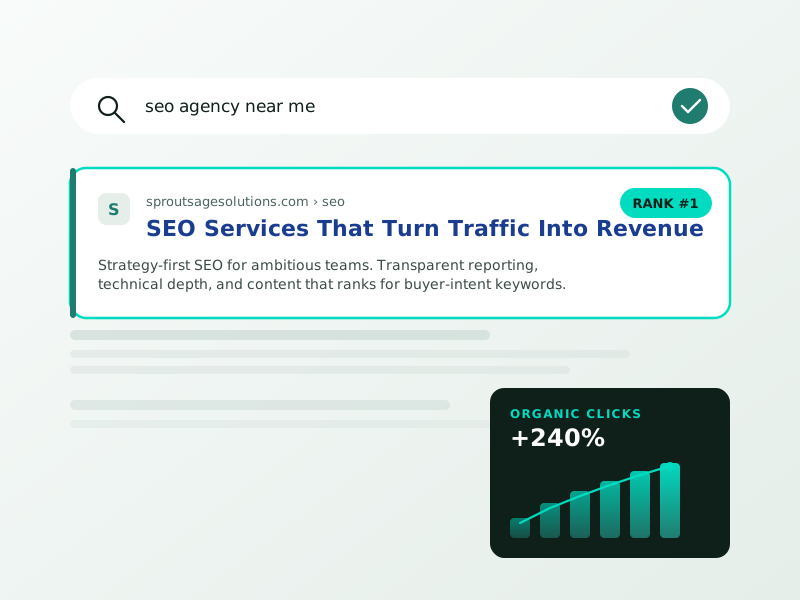
Real medspa marketing results from 65+ practices, what actually happened when we ran SEO, Google Ads, and content campaigns for independent medspas across the US, UK, and Canada.
Table of Contents
- Why Most Agencies Won't Publish This
- How to Read These Results Honestly
- Case Study 1: Las Vegas Medspa, Body Contouring and Injectables
- Case Study 2: Nashville Medspa, Pre-Wedding and Bachelorette Niche
- Case Study 3: Suburban Chicago Medspa, Starting From Zero
- Case Study 4: San Diego Medical Spa, Competitive Market
- Case Study 5: Texas Medspa Group, Three Locations
- The Metrics We Actually Track (And Why the Common Ones Are Misleading)
- What You Can Realistically Expect: An Honest Timeline
- What's Typically Included When You Work With Sprout Sage
- Get a Free Audit of Your Current Marketing
Most medspa marketing agencies publish results. Almost none of them publish real ones.
You’ll see screenshots of Google Ads dashboards with 600% ROAS (that nobody can actually trace to revenue), testimonials that say “we’re so happy with the team,” and before/after traffic charts with no mention of whether any of those visitors actually booked appointments.
This page is different. It documents real outcomes from real practices, new patients booked, cost per booking, revenue impact, with enough context to make the numbers meaningful. Nothing cherry-picked. Nothing rounded up to the nearest impressive figure.
—
Why Most Agencies Won’t Publish This
Transparency about results requires confidence in your results. Most agencies don’t have that confidence, not because they’re bad at their jobs, but because their internal tracking doesn’t connect the work they do to the outcomes clients actually care about (appointments booked, revenue generated). If you can’t measure it, you can’t publish it.
At Sprout Sage Solutions, we’ve built our entire reporting infrastructure around the metrics that matter to medspa owners: new booked appointments, cost per booking, patient retention rate, and revenue impact. We track these across all 65+ of our active practices. When we look at our own data, we can say with confidence what’s working, what’s not, and why.
That’s why we’re publishing this. Our numbers hold up to scrutiny.
—
How to Read These Results Honestly
Before you look at the case studies, some important context.
Results vary significantly by market. A medspa in Las Vegas or Miami competes in a fundamentally different environment than one in a mid-size Midwest city. Google Ads CPCs, organic competition levels, and market sophistication all differ. A cost-per-booking of $48 in Vegas might be $32 in Tulsa and $85 in Beverly Hills.
Your starting point matters. A medspa with zero online presence has different early-stage results than an established practice with 200 Google reviews and an existing patient base. We’ve tried to note starting conditions for each case study so you can calibrate.
Front desk responsiveness is a real variable. We’ve seen medspas get 40 inbound calls in a month and book 12 of them because the front desk doesn’t pick up consistently or doesn’t follow up on missed calls. Marketing generates inquiries, your team converts them. We factor this in when evaluating results, and we flag it when it’s limiting performance.
Budget level affects velocity, not direction. Higher ad spend produces results faster. Lower spend (starting at $800/month all-in) produces the same results more slowly. The trajectory is the same; the timeline differs.
With that context established, here’s what actually happened.
—
Case Study 1: Las Vegas Medspa, Body Contouring and Injectables
⚡ 2-minute scorecard · instant result
Is your medspa marketing actually converting?
Answer 5 quick questions. Get your score + the top fixes, free.
1. Can patients book online 24/7 without calling?
2. Do you respond to new inquiries in under 5 minutes?
3. Do you run a membership or recurring-revenue program?
4. Are you retargeting site visitors with ads?
5. Are you generating fresh reviews every month?
Market: Las Vegas, Nevada Services: Body contouring (CoolSculpting, Emsculpt), neurotoxins, dermal fillers Starting point: 8 new patients per month, no Google presence, $0 in active ad spend, 14 Google reviews
The Challenge
This medspa had been open 18 months and was surviving on word-of-mouth and one loyal aesthetician’s social following. The owner knew she needed to build a real acquisition channel but had been burned by a previous agency that ran ads for 4 months and couldn’t explain where the budget had gone.
What We Did
Month 1: Full GMB optimization (photos, service descriptions, Q&A, weekly posts), website technical SEO audit and fixes, conversion rate audit on existing website.
Month 2: Google Ads launch, core campaign targeting “medspa Las Vegas,” “CoolSculpting Las Vegas,” and surrounding treatment queries. Separate landing page for body contouring (the practice’s highest-ticket service).
Month 3: Added a tourist overlay strategy unique to the Vegas market, campaigns and landing page copy specifically targeting visitors searching for “quick treatment before event,” “same-week CoolSculpting,” and “Vegas bachelorette medspa.” Las Vegas has a large population of visitors who want high-quality aesthetic treatments during their trip and are willing to pay for same-day or next-day availability.
Results
| Metric | Month 1 | Month 3 | Month 6 |
|---|---|---|---|
| New patients/month | 8 | 22 | 31 |
| Cost per booking | , | $61 | $48 |
| Google reviews | 14 | 29 | 47 |
Revenue impact: At an average ticket of $380 (blended across services), the increase from 8 to 31 new patients per month represents approximately $8,700 in incremental monthly revenue from new patients alone, not counting same-patient rebooking, which adds another layer.
What made the difference: The tourist campaign. Las Vegas is unique in that a meaningful percentage of your potential patients are not local, they’re traveling for events and will pay a premium for convenience. Most medspa marketers miss this entirely because they’re applying standard local SEO thinking to an anomalous market. Targeting that visitor psychology explicitly drove 30–35% of new bookings by month 6.
—
Case Study 2: Nashville Medspa, Pre-Wedding and Bachelorette Niche
Market: Nashville, Tennessee Services: Neurotoxins, lip filler, hydrafacial, body treatments Starting point: Good reviews (61 Google reviews, 4.9 stars), strong word-of-mouth, very limited online visibility, 6 new patients per month from digital channels
The Challenge
Nashville has become one of the top bachelorette destinations in the US. This medspa was located 10 minutes from the downtown strip and had no idea how to capture that traffic. Their existing patients loved them, but new patient acquisition through digital channels was effectively zero.
What We Did
Month 1: SEO gap analysis revealing that bachelorette/pre-wedding queries had meaningful search volume in Nashville and zero local medspa competition for them. GMB optimization. Content strategy built around the bachelorette and pre-wedding opportunity.
Month 2: Launched three blog posts targeting “Nashville bachelorette medspa,” “pre-wedding treatments Nashville,” and “medspa packages for groups Nashville.” Built a dedicated bachelorette landing page with a group booking inquiry form and package pricing.
Month 3: Instagram ad campaigns targeting Nashville-area event planners and bachelorette planning accounts. Retargeting campaign for landing page visitors.
Month 4: Refined campaigns based on data. Added a group discount trigger (book 4 or more and receive 15% off) displayed on the landing page.
Results
| Metric | Month 1 | Month 4 |
|---|---|---|
| New patients/month (digital) | 6 | 18 |
| Bachelorette group bookings | 0 | 8/month |
| Average ticket (regular) | $380 | $390 |
| Average ticket (bachelorette group) | , | $650+ |
Revenue impact: The 12 additional regular new patients represent approximately $4,560/month incremental revenue. The 8 bachelorette group bookings, at a $650+ average ticket, represent another $5,200/month. Total incremental: approximately $9,760/month at the 4-month mark.
What made the difference: The group booking mechanism. Individual bachelorette visitors were already coming to Nashville, no one had built a medspa experience specifically for them. The dedicated landing page with group pricing and a group-specific inquiry form created a conversion path that didn’t exist before. The Instagram campaign amplifying to event planners (who book these trips for others) was the distribution channel that scaled it.
—
Case Study 3: Suburban Chicago Medspa, Starting From Zero
Market: Suburban Chicago (DuPage County area) Services: Neurotoxins, dermal fillers, laser treatments, medical-grade facials Starting point: Brand new medspa, zero reviews, no website presence, no existing patient base
The Challenge
Most marketing agencies tell new medspas the same thing: “You need 6 months before we can really start.” That’s partially true but mostly an excuse for not having a launch strategy. We approach new medspa launches differently, the first 60 days are infrastructure, and we start generating patients from day 30.
What We Did
Month 1: GMB build and optimization from scratch (verified, fully built out, photos, services). Website SEO technical foundation. No ads yet, new domains need a few weeks of credibility before paid campaigns perform efficiently. Launched review request sequence through email and SMS to the owner’s personal network and anyone who came in for a soft-opening.
Month 2: Google Ads launch once GMB had 12+ reviews and the site had initial indexation. Conservative budget ($600/month in ad spend) targeting high-intent local queries. Focus on neurotoxins and filler, the services with the most volume and fastest decision cycles.
Month 3: Expanded campaigns. Added retargeting. Began blog content targeting local neighborhood-level searches (“medspa [specific suburb]” and “Botox [specific suburb]”).
Month 4–6: Continued SEO content build. Ads optimization based on conversion data. Review count growing through automated post-visit sequences.
Results
| Metric | Month 1 | Month 3 | Month 6 |
|---|---|---|---|
| New patients/month | 3 | 14 | 26 |
| Google reviews | 0 | 19 | 34 |
| Cost per booking (Google Ads) | , | $74 | $52 |
| GMB profile views | 120 | 890 | 2,100 |
Revenue impact: At month 6, 26 new patients per month at an average ticket of $360 = $9,360/month in new patient revenue. For a medspa that started with zero, that’s a functional acquisition engine in 6 months.
Key insight: New medspa timelines are honest timelines. Month 1–2 is foundation work that doesn’t show dramatic numbers. Month 3 is when the inflection happens, because the GMB credibility, initial SEO signals, and ads optimization all converge. Any agency promising you 30 new patients in month 1 for a new practice is either lying or running unsustainable tactics that will break.
—
Case Study 4: San Diego Medical Spa, Competitive Market
Market: San Diego (La Jolla / Carmel Valley area) Services: Full-service, injectables, laser, body contouring, skin resurfacing, membership program Starting point: Established medspa, 4 years in operation, 15 new patients/month, inconsistent marketing, no membership program
The Challenge
San Diego, and especially La Jolla, is one of the most competitive medspa markets in the United States. The practices competing for the same patients in this market are well-funded, well-staffed, and well-marketed. Standard playbook approaches get lost in the noise.
This medspa was established and had strong reviews, but their marketing had been inconsistent, a few months of ads here, some social posts there, no coherent strategy. 15 new patients per month was below what the practice was capable of and below what the market could deliver.
What We Did
Month 1: Full audit of competitor positioning and keyword gaps. Most competitors were targeting broad San Diego terms, expensive, competitive, and poorly converting. We identified a hyper-local opportunity: neighborhood-level targeting for La Jolla, Carmel Valley, Del Mar, and Rancho Santa Fe separately. Also designed a membership program structure optimized for new patient conversion.
Month 2: Restructured Google Ads around neighborhood-level targeting. Separate campaigns for each micro-market with messaging tailored to each community’s buyer profile (La Jolla messaging differs from Carmel Valley messaging in meaningful ways). New landing pages per neighborhood.
Month 3: Launched the membership program (“Glow Club”), $199/month including one neurotoxin treatment, 20% off all other services, priority booking. Membership positioned on the website, in post-visit follow-up email, and in a dedicated Google Ads campaign targeting “medspa membership San Diego.”
Month 4: Refined campaigns. Added Gmail/Display retargeting for high-value service pages.
Results
| Metric | Baseline | Month 4 |
|---|---|---|
| New patients/month | 15 | 28 |
| Cost per booking | ~$90 (estimated) | $61 |
| Membership enrollments/month | 0 | 5–7 new members |
| Monthly recurring revenue (memberships) | $0 | $4,100+ |
Revenue impact: 13 additional new patients at $450 average ticket = $5,850/month additional new patient revenue. Membership MRR of $4,100/month adds a revenue floor that makes the entire marketing investment significantly more stable, and provides a retention mechanism that keeps patients coming back monthly.
Key insight: In highly competitive markets, winning on broad terms is expensive and often not worth it. Winning on hyper-local, neighborhood-specific terms costs less and converts better because the intent is sharper. The membership program was the unexpected multiplier, it converted a percentage of new patients into recurring revenue immediately, which fundamentally changed the unit economics of the marketing investment.
—
Case Study 5: Texas Medspa Group, Three Locations
Market: Texas (Austin metro, two suburban satellite locations) Services: Full-service medspa across all three locations Starting point: 3-location group spending $6,000/month across two separate agencies, unclear attribution, 65 total new patients/month group-wide
The Challenge
This client came to us not because their patient volume was bad, 65 new patients/month across 3 locations is reasonable, but because they had no idea what was actually working. Agency A was handling the flagship Austin location and reporting great CPCs. Agency B was handling the suburban locations and reporting great impressions. Nobody was tracking actual booked appointments with any rigor.
The owner suspected significant budget waste but couldn’t prove it because the tracking was broken. She was spending $6,000/month and had no idea which of those dollars were producing patients.
What We Did
Month 1: Tracking and attribution rebuild. Deployed call tracking numbers per campaign, per channel, and per location. Set up Google Ads conversion tracking tied to appointment confirmations (not just form submissions, actual confirmed bookings synced from their scheduling software). Unified reporting dashboard across all three locations.
Month 2: Budget analysis with real attribution data. Discovery: one location had been spending $1,800/month on Display ads that had produced 2 confirmed bookings in 90 days. Another campaign had been “optimizing for form submissions”, 60% of which were duplicate form submits and spam. After correcting the data, the actual cost per booking was 2.4x what the agencies had been reporting.
Month 3: Redeployed budget. Eliminated campaigns with no real attribution. Consolidated to the highest-performing keywords and campaigns per location. Total spend reduced to $2,800/month (saving $3,200/month) with the same search impression share on the terms that were actually converting.
Results
| Metric | Before | Month 3 |
|---|---|---|
| Monthly spend | $6,000 | $2,800 |
| New patients/month (group) | 65 | 66 |
| Reported CPB (agencies) | $42 | , |
| Actual CPB (verified) | ~$101 | $58 |
| Monthly savings | , | $3,200 |
Revenue impact: Same patient volume at $3,200/month less in spend. Over 12 months, that’s $38,400 in recaptured budget, without losing a single patient.
Key insight: Multi-location groups often overpay for marketing not because their agencies are doing bad work, but because tracking is broken. When you can’t see what’s actually working, you keep spending across everything. Fixing attribution is not glamorous, but it’s often the highest-ROI thing we do in the first 90 days. This client’s marketing wasn’t underperforming, it was underreported. Fixing the measurement changed everything.
—
The Metrics We Actually Track (And Why the Common Ones Are Misleading)
After working with 65+ medspas, we’ve learned which metrics actually predict business outcomes and which ones agencies report because they look good.
What we track:
New booked appointments. Not leads. Not form submissions. Not “inquiries.” Actual appointments that were booked into the schedule. This is the only metric that directly connects marketing to revenue.
Cost per booking (CPB). Total marketing spend divided by confirmed booked appointments. This normalizes across channels and campaigns so you can see where your dollar goes furthest.
90-day retention rate. Of new patients acquired through marketing, how many return within 90 days? High CPB is tolerable if retention is strong (you’re acquiring patients who become long-term relationships). Low CPB is deceiving if retention is poor.
Revenue generated vs. marketing investment. At the end of each quarter, we calculate total revenue attributable to marketing-sourced new patients. This gives you a true ROI number, not a channel metric.
What we don’t report (and why):
Impressions and reach. Impressions don’t book appointments. A campaign can have 50,000 impressions and zero bookings. Reporting impressions as a primary metric is a way to show activity without accountability for outcomes.
Follower count and engagement rate. Social following doesn’t directly produce new patients at meaningful scale for most medspas. Follower growth is a lagging indicator at best and a vanity metric at worst. We run social ads when they produce bookings; we don’t prioritize organic follower growth as a KPI.
Cost per click. CPC matters for budget efficiency, but a low CPC on keywords that don’t convert is worse than a high CPC on keywords that do. CPC is an input metric, not an outcome metric.
—
What You Can Realistically Expect: An Honest Timeline
We get asked all the time, “how soon will I see results?” The honest answer depends on your starting point, but here’s a general framework based on 65+ engagements.
Month 1: Infrastructure and Foundation SEO technical fixes, GMB optimization, ad campaign build, conversion tracking setup. You may see a small uptick in inbound inquiries from GMB improvements, but this month is primarily setup. Anyone promising 20 new patients in your first month either has an unusually strong starting foundation or is running tactics that will look bad by month 3.
Months 2–3: Early Results Google Ads start producing booked appointments. GMB visibility grows. First SEO signals emerge. You should be seeing measurable new patient volume from digital channels by the end of month 3, not your full potential, but a real, trackable baseline. Cost per booking is typically highest in this period as campaigns optimize.
Months 4–6: Consistent Pipeline Campaigns have enough data to optimize effectively. SEO content begins to generate organic traffic. Cost per booking typically drops 20–40% from the month 3 level. This is where the “marketing machine” starts operating consistently rather than in bursts. New patient volume stabilizes into a predictable monthly baseline.
Month 6+: Compounding Returns SEO rankings continue to grow (organically acquired patients become zero-incremental-cost). Email/SMS reactivation campaigns generate revenue from existing patients. Referral systems amplify word-of-mouth. At this stage, you’re building equity in your digital presence, not just renting traffic.
Red flags that suggest something is wrong:
- No trackable new patients by end of month 3
- Agency can’t show you actual booking data (only clicks and impressions)
- Costs going up without volume going up
- No explanation of what changed between months when results shift
Any agency worth hiring should be able to explain month-to-month performance clearly and honestly, including when things aren’t working and why.
—
What’s Typically Included When You Work With Sprout Sage
For context on how these results were produced, here’s what a standard engagement includes:
- Google Business Profile optimization and ongoing management
- Local SEO, technical, on-page, and content
- Google Ads management (Search, local campaigns)
- Landing page builds for high-priority services
- Email/SMS automation for post-visit follow-up and reactivation
- Monthly reporting with verified booking data
Starting at $800/month. No contracts. No setup fees. One medspa per market.
—
Get a Free Audit of Your Current Marketing
If you’re doing 15+ new patients per month and want to push past that plateau, or if you’re starting from scratch and want a realistic plan, start here.
A free 30-minute audit includes:
- Review of your Google Business Profile, website, and current ad account (if applicable)
- Identification of your top 3 priority gaps
- Specific, actionable recommendations, whether you hire us or not
No pitch structure. No obligation. If a different agency is the right fit for your situation, I’ll tell you.
Book your free 30-minute audit: https://calendly.com/workwithmandeep/30min
Or reach out directly via WhatsApp: +91 9729712388
—
*Sprout Sage Solutions, medspa marketing only. 65+ practices across the US, UK, Canada, and Israel. Market exclusivity guaranteed. No contracts.*
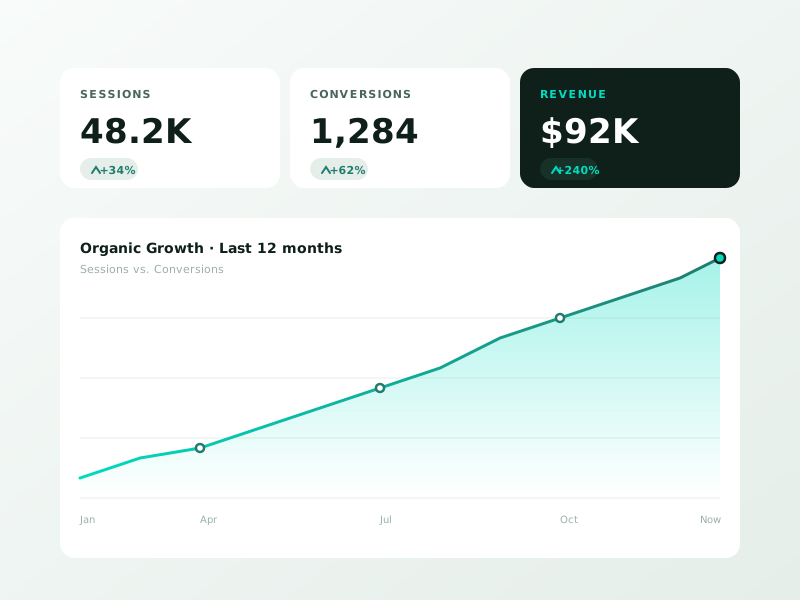
Ready to turn this into real bookings?
Free 30-min audit. We review your current setup and give you 3 specific wins — whether we work together or not. Starts at 0/month. No contract. One medspa per market. Book a free 30-minute strategy call, I will review your setup and give you 3 specific fixes.
Book My Free Audit →No credit card. No pitch. No 12-month lock-in.



